Showing posts with label books. Show all posts

Tuesday, February 9, 2016

Book Commentary -- Tribal: College Football and the Secret Heart of America

Diane Roberts, Tribal: College Football and the Secret Heart of America. New York: Harper-Collins, 2015.

More book commentary, while I'm completely blocked on an Ash Wednesday message...for tomorrow.

Have you ever had the experience of hearing a speaker with whose argument you agree, and whose basic points you readily acknowledge as valid and factual, and yet all you can think as they continue to speak is "oh, good LORD, get ON with it already!!"? That's roughly the experience of reading Diane Roberts's Tribal: College Football and the Secret Heart of America.

Roberts is a darling of the NPR crowd and contributor to the likes of Oxford American (vouching for her Southernness cred with a particular crowd) and the Guardian (international credibility). She's a faculty member at FSU (where she also studied, along with a degree from Oxford), after some years at the University of Alabama. And she's a college football addict, the type who tosses around phrases like "these are my people" when talking about college football and its fans. This after conducting a thorough and thoroughly snarky dissection of everything those fans love and represent.

The book is, cleverly, divided into four quarters with a pregame, halftime, and postgame. Each quarter has five chapters organized around a general theme, with the exception of the third quarter, on gender and college football, which inexplicably has only two. The other three quarters touch on the tribal hatreds of college football, religion (read: Christianity) and college football, and race and "Southernness", respectively, although the last chapter of the fourth quarter diverges somewhat into the saga of Bobby Bowden's fall at FSU. (The "halftime" chapter mostly focuses on the hazing/murder of the drum major of Florida A & M University's Marching 100 in 2011, with a few mentions of other band misbehaviors.)

Clearly all of these subjects provide ample fodder for one who wants to take college football apart, and Roberts pulls out all the stops in doing so. She doesn't spare her beloved FSU by any means (the Jameis Winston debacle gets a major airing-out) but plenty of schools get skewered.

For those who know Roberts's NPR commentary or other writing projects, the voice will be familiar. It may come off a bit more strident than in some cases. Possibly this comes, one might suspect, with taking a hatchet to a phenomenon to which one has already declared one's loyalty and unwillingness to give up. The whole tone of going on and on and on gets more than a little annoying.

There are parts of the book that are actually indispensible. It is particularly touching and harrowing when Roberts returns to her experiences tutoring athletes at FSU lo, those many years ago, young boy-men given to arrogance on the field, not always able to live up to that bravado when confronted with things like classes that are beyond their capacity. When the humans who are both at the center of and decidedly at the bottom of the pecking order in college football come into focus, the book is actually compelling.

Of course, there is one issue that Roberts somehow manages to dance around for most of the book's longer-than-it-looks length, one which this blog doesn't allow you to overlook, of course -- the issue which is largely unavoidable in football these days. And yet largely, it is avoided here, or made mostly an object of snark.

It seems that Roberts mostly regards the "concussion crisis" as (a) the ultimate bogeyman that will finally undo the NCAA (possibly, I guess), or (b) the ultimate bogeyman that will take away her beloved college football. Of course Roberts would never be so gauche as to say that directly, but that's about the only thing one can draw from her few comments on the subject. You would think that an academic thinker like Roberts might do more with the brain-trauma issue -- connect it to the racial issue, as more affluent (and frequently more white) players might have the luxury to pull a Chris Borland, while poorer (and frequently blacker) athletes will see themselves with fewer options. But really, Roberts just doesn't seem up to the task of confronting that issue squarely.

But I suppose when one of the key phrases of her "pregame" is "I accept and embrace my Inner Barbarian," and she waxes poetic about being unable to quit the game the way one can't quit a bad boyfriend, that was probably too much to hope for.

[An aside: stepping back from Roberts's tome, this seems like a place to point out a basic ethical principle at play here. For her being a college football addict is an identity, one bred into her over pretty much her whole life. For any Christian, though, this is an excuse, not a reason. From the point of view of this blog (seeking to understand and act on football and its damage to children of God from a Christian-ethical viewpoint), we have to do better than retreating to talk of identity. After all, people who are actually following Christ, or even trying to do so, have a higher identity, do we not? And when that identity (for which the word "Christian" used to be useful before becoming overly politicized) comes into conflict with any of our other human identities, or when those human identities demand of us compromises that cannot be squared with our allegiance to Christ, then which allegiance is supposed to win?]


Tuesday, February 2, 2016

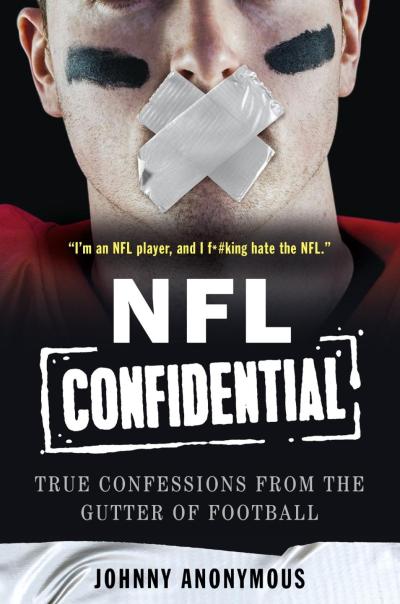
Book Commentary -- NFL Confidential: True Confessions From the Gutter of Football

Note: the ethical discussion will continue, but I got hit by a school bus today and don't frankly have the energy to give to that argument as is needed. (I'm OK, my car probably isn't.) That discussion will continue, and will probably feature the long-awaited comparison of football to the gladiatorial games of ancient Rome.

"Johnny Anonymous," NFL Confidential: True Confessions From the Gutter of Football. New York: Dey St. (Harper-Collins), 2016.

Short review: don't bother. Really.

This falls in a long line of books that promise heaps of scandal and deliver nothing you didn't already know. This seems less a tell-all than a spec script for one of those cheap and cheesy football-based series that turn up on HBO or some similar network on occasion.

The author is (or is claimed to be) an NFL player, active during the 2014-15 season. (I wouldn't be shocked if this turns out to be one big punking, but if so it wasn't a terribly successful one.) Mr. Anonymous purports to hate the NFL. It says so right there on the book jacket: "I'm an NFL player, and I ----ing hate the NFL." (I am leaving a bit more mystery about that expletive than the book jacket does, but I'm guessing you can fill it in.) His stated aim at the outset of the book is to be the Best NFL Backup Ever (c), in essence to make an NFL paycheck without actually doing anything besides riding the bench. So one of his first moves is to demonstrate that he's not nearly as smart as he claims to be, if he seriously thinks all the players ahead of him on the depth chart are going to stay healthy through a whole season in the NFL (he's an offensive lineman, in more ways than one).

It gets worse. Under the guise of being honest, he unveils his own raging homophobia (you might remember Michael Sam was trying to make it in the NFL at the time). His revelations about locker-room attitudes towards everything from women to their own coaches are probably meant to be dramatic and shocking, but you're pretty unlikely to be surprised if you've ever seen a few episodes of Hard Knocks, and probably won't be surprised even if you haven't.

Without too much elaboration: Mr. Anonymous's plans go awry when the team's starting center is injured, and Johnny has to step in. All the supposed pent-up rage dissolves, as Johnny's perhaps long-buried yearning to hit people kicks in and he remembers that he actually likes playing football, and if that means loving the NFL, so be it. His original plan to play the one season and then get out is, presumably, out the window, as he is (as of the book's printing) back with the same team for this about-to-end season.

It's not the scandalous book it claims to be, and its central character isn't nearly as interesting as he thinks he is. Save your money for something better.

Added: somebody thinks he knows who Johnny Anonymous is. Sounds reasonably plausible, but honestly, after reading the book I really don't care.


Tuesday, December 22, 2015

Hollywood jumps in!

With the absolute and unyielding avalanche of publicity and unbridled geekery heralding the release of Star Wars: The Force Awakens this past weekend, you might not be aware that other movies are being released this holiday season. (I think in this case "holiday season" is the best term. I mean, really, do we really want Sisters or The Big Short somehow tied to the child in the manger? I didn't think so.) But there are, and one of them is of great interest to this blog, and not because it represents Will Smith's first serious bid for an Oscar nomination in years.

Indeed, this Friday marks the release of Concussion, a movie based on the experience of Dr. Bennet Omalu, the Nigerian-born medical examiner whose examination of the brain of former Pittsburgh Steeler Mike Webster set off the ill-labeled "concussion crisis" that now haunts not only the NFL, but every level at which football is played, and other sports as well.

I have no advance knowledge of the film itself that anybody else can't obtain. (No, this blog has not earned me admittance to a Hollywood premiere or any advance screening. Shame, I know.) It's not hard to guess the basic outlines of the movie, however, if you've either read the book League of Denial: The NFL, Concussions, and the Battle for Truth, by Mark Fainaru-Wada and Steve Fainaru, which features Omalu's work prominently as part of its narrative. If books aren't your thing, you could also watch the PBS Frontline episode based on the book and featuring interviews with many of its principals, including Omalu. If you are dubious about ordering DVDs, the doc airs again this month, with part 2 of an expanded version airing tonight on many PBS stations. (It does air on the local station tonight ... at 3:00 a.m. I wonder if this is a pattern in other football-besotted towns.) Or after tonight you could probably stream it from PBS.org.

The Fainaru brothers are good at what they do, and the book and/or documentary are worth your time independent of the coming Hollywood treatment. But it's the Hollywood story that confronts us this weekend. Hopefully I'll see it some time this weekend, when family and/or church obligations allow, and have some hopefully useful comments on it. But trying to guess or anticipate what happens allows for a comment or two

1) It is Hollywood, folks. There is a documentary on concussions in the NFL, and it's noted above. This will not be a documentary. Some amount of representational storytelling will happen. Based on some commentary I've heard, some of that "representational storytelling" will involve Dave Duerson, the former Chicago Bears linebacker whose suicide, shooting himself in the chest apparently in order to preserve his brain for examination, marked perhaps the most publicly striking moment in the ongoing crisis before the suicide of Junior Seau. The movie appears to include a scene in which Duerson attempts to prevent Omalu from reporting his findings at a medical conference. This didn't happen. However, Duerson was an early key figure in debunking any connection between football and CTE, even testifying to a senate subcommittee in defense of an NFL committee's denial of disability benefits to former players, a stance which still angers a number of former players affected by that denial. (For now I'm leaving aside the columnist's apparent eagerness to be judge and jury of how affected former players really were or weren't by CTE when committing suicide.) Players like Brent Boyd take no particular pleasure in Duerson's being claimed by the malady whose existence he denied (not unlike a climate change denier being drowned when his home washes away due to rising seas, I suppose). At any rate, while the particular incident between Duerson and Omalu didn't happen, Duerson's bitter denial of these effects is not inaccurate, and any attempt to defend him against being "smeared" by the movie rings hollow.

2). It is Hollywood, folks. While the movie can't get away with too much Hollywooding, it has several aims besides toppling the NFL or sounding the alarm over concussions. It wants to make money. It wants to win awards. Will Smith definitely wants that Oscar. These are basic cautions any moviegoer should exercise when watching a "fact-based" movie. That said, expect pushback from the NFL and organizations allied with it.

Also in the run-up to the film's release, some of its principal charaters are emerging in the media. Omalu himself showed up with an opinion peace in the New York Times with the radical suggestion that kids shouldn't play tackle football, period. Reaction, ranging from panicked to outraged, followed. Dr. Julian Bailes, a doctor who was an early guide to Omalu (and is played by Alec Baldwin in the film), showed up on the ESPN Radio program Mike & Mike in the Morning. Bailes's principal motivation seemed to be to defend football as a sport, particularly football for children and adults. The very same platitudes the NFL always repeats ("football has never been safer" for example) come right out of Bailes's mouth, as well as the extremely deceptive claim that "they knew the risks" in reference to children and youth in football, including his own sons. (To be fair, the Mikes -- Greenberg and Golic -- don't really let up on their questions in the face of his mindless platitudes, doing a reasonably good job of playing the role of concerned parents.) Perhaps the most horrifying thing to comes out of his mouth is the suggestion that high-school players who die as a result of on-field brain injury would probably have died of something else or other anyway. At any rate, his own compromised nature is at least admitted up front when he acknowledges serving as a volunteer adviser to the national Pop Warner football program for kids.

That looks really bad now, in light of a court ruling allowing a lawsuit against Pop Warner football by the family of a youth who was paralyzed as a result of a head-on hit they allege was instructed by his coaches. Paralysis isn't concussion, but the charge that a coach was directing players to hit head-first demonstrates the degree to which no football organization has the ability (or, frankly, willingness) to monitor its coaches and their teaching of proper techniques. That kind of thing is left up to you, the parent of a would-be youth football player, who is expected to know these things (even though they're not always being very forthcoming about those things).

What is striking is the difference between Bailes, who played himself and has two sons who played, and Omalu, who had about as little knowledge of football as it is possible to have when Mike Webster showed up on his examination table. Omalu, who I'm assuming will be portrayed as more saintly than he is in the movie, said what he saw. Bailes, suddenly seeing his sport threatened, begins to distance himself from what he has already seen.

This kind of thing doesn't augur a lot of hope for non-medical professionals who grew up with fierce attachment to football, whether they played or not, and are now faced with the moral quandry of justifying the game that probably holds primary allegiance in their lives (and no, I am not exaggerating; even if I've only been a pastor less than a year I have no illusions about how the church does in comparison. If you've seen one of the movie trailers you've heard the line about how the NFL owns the day of the week the church used to own; the only thing remarkable about the line is its utterly non-controversial nature) in the face of its obvious life-debilitatig damage to a major portion of its players.

How do you react to a condition that you can't see happening, that is (even the NFL expects) likely to tear down the lives of about a third of its players?

At any rate I'll go see the film as soon as I can, and I hope you will too, and be motivated to dig deeper.

Will Smith bids for a statue and hopefully pushes the discussion along in the process.

Wednesday, June 10, 2015

"Moneyball," Moneyball, and the Church?

So last week, my Twitter feed produced a link to a column by a pretty well-known blogger in progressive-evangelical circles, putting forward the notion that the church needed to embrace the principles laid out in Michael Lewis's best-selling book Moneyball. Being a guy who occasionally traffics in the intersection of sporting culture and faith issues, this naturally caught my eye, but a few "wild pitches" found in the blog column (in terms of its description of Moneyball in its baseball context strictly) put my suspicion antennae on high alert. I made the mistake of acknowledging this on Twitter, which led to my being questioned about the hackles-raising points, which obligated me to respond (albeit tardily), which is resulting in this blog post.

Image: baseballphd.net

For the uninformed, Moneyball is Lewis's account of the 2002 Oakland Athletics under the leadership of general manager Billy Beane (and also the title of the Brad Pitt movie based on the book). This leads to the first "wild pitch" in the column: Beane is general manger of the Athletics in the book, not manager, as the blog post states. This may seem trivial but is desperately important; it is the general manager in most organizations who bears principal responsibility for acquiring players for the team, whether via draft or trade or free agent signing. As a manager, Beane would have had little opportunity to put his ideas into action; even as general manager Beane faced stiff opposition from many parties in the A's organization -- principally the team's scouting staff, steeped in traditional, non-statistical player evaluation beliefs, and the team's actual manager at the time, Art Howe.

Another "wild pitch": I'm not quite sure to what the author is referring when he speaks of "a company called Saber Metrics." I've never heard of it, and I like to think I'm enough of a sports fan that I would have. What I do know of is sabermetrics, not so much a company as a practice of empirical analysis of baseball. (Sabermetrics, or advanced statistical analysis in general, has started to expand to other sports as well, with basketball perhaps being most notable.) The term "sabermetrics" is derived from SABR, the acronym of the Society for American Baseball Research, an organization founded in 1971 and espousing baseball research of all kinds (historical research has long been a strong suit of the group), not just statistical analysis. However, a number of SABR members (most famous of whom are probably Bill James, statistical analytics guru who published occasional editions of the Bill James Baseball Abstract for diehard stat geeks and is now with the Boston Red Sox, and Rob Neyer, sabermetrician and author long affiliated with ESPN.com and now with FOXSports.com) did engage in the use of advanced statistical methods to engage with baseball and its results, including developing new statistics intended to gauge baseball performance more accurately. Beane himself was/is not necessarily a sabermetrician himself, but made the decision to make use of these advanced analytical tools in his role with the Athletics. (More on this later.)

Another "wild pitch" (or at least curveball in the dirt): it's a stretch to say that Beane's teams were or are "playoff contenders ... year after year." While there have been a number of highly successful teams during Beane's tenure, there have been rough years as well (this year's team looks like one of the latter so far). A look a the franchise's history shows that, since Beane took over as GM in 1997 (after first working for the club as a scout), after a slow start, the team peaked around 2001-2002 (the period covered in Lewis's book), declined over time to a pretty rough stretch from 2007-2011, and rebounded with three straight playoff appearances 2012-2014. One could argue that the Tampa Bay Rays (full disclosure; the closest thing I have to a "local" team right now) have had a somewhat more consistent run of success since their playoff breakthrough in 2008, while being run under similar principles (and with maybe even less money).

Another factor to be considered is that for all the success across regular seasons, the team has yet to win a playoff series under Beane's tenure. Beane himself famously acknowledged this with the earthy declaration "my s*** doesn't work in the playoffs," attributing playoff success or failure in general to luck. (He's probably not completely wrong about this, but that's another column, the theological implications of which I'm not sure about.) This isn't a reason to dismiss the success of Beane's work, but should not be forgotten in seeking to apply the concepts elsewhere, including the church.

Now, as far as the actual application of "Moneyball" principles in the church realm, there are definitely possibilities there. But it matters what we understand those principles to be, and even those in baseball tend to get them wrong. For a number of years folks tended to leap to the conclusion that Beane's tactics were about acquiring a specific type of player (for example, one who was particularly skilled at getting on base) at the expense of another (e.g., one who hit a lot of home runs). Beane would have been plenty happy to load his lineup with power hitters, but because other teams with larger budgets could and did pay more for power hitters, Beane needed to find a way to acquire players who could contribute enough to the team without spending sums of money the team's ownership wouldn't approve. Thus, as teams such as the New York Yankees or Boston Red Sox loaded up on power hitters, Beane went in search of players skilled at getting on base.

Perhaps the most famous example of this in Moneyball was Scott Hatteberg, a lifetime backup catcher until being signed by Beane for the 2002 season to replace power-hitting Jason Giambi, who was siphoned off as a free agent by the big-bucks Yankees. If you know baseball, you know Giambi was a first baseman, not a catcher, but this didn't faze Beane, who signed Hatteberg anyway and put his coaches in charge of teaching him to play a new position. Hatteberg indeed went on to have a reasonably successful season for the A's in 2002.

At any rate the biggest takeaway from Moneyball in this respect is to "zig where others zag," using one's limited resources most efficiently by prioritizing players with skills less valued by other teams. Of course the problem is accentuated when other teams, particularly teams with bigger budgets than yours, start to appropriate your methods. The Red Sox in particular began to invest more in advanced analytics, to which they could then apply their much larger player-salary budgets. Their run of success from 2004 (their first World Series win in 86 years, as we heard about ad nauseam that year) through 2013 was largely fueled by this combination of analytics and budget, or "Moneyball with money" as some have called it.

Here, I think, is a potential pitfall for applying Moneyball principles in the church. In responding to other teams' appropriation of statistical analysis, Beane has quite notorious for ruthlessly trading "assets" before they reach their free-agent years, in order to guarantee getting some return on the investment the team has made in them. (At this point Beane's methods seem most about the collection of young -- and therefore affordable -- talent, while occasionally taking chances on risky players such as those recovering from injury.) As this year's team struggles, observers expect a "fire sale" of talent to kick in soon, as Beane seeks to retool and reload the young talent in the A's organization rather than pouring resources into a lost season.

If this sounds rather impersonal, well, it is. Players who think they've found a home in Oakland are suddenly shipped across the country without so much as a thank-you card. (Third baseman Josh Donaldson, now with the Toronto Blue Jays, would be a prime example from this past offseason.) Even if one is applying these Moneyball principles to the activities or programs of the church, one had better remember that there are people attached to those activities or programs, people who can't be traded or released. A church simply can't proceed as if personalities are not involved in its activities.  A church may seek efficiency, but it probably shouldn't be "ruthlessly efficient." There is at least some risk of getting caught in a different form of what many outsiders like to charge against megachurches or heavily evangelical churches; treating people as numbers.

Another general principle of Moneyball tactics, not necessarily restricted to Beane and the A's, can be loosely summarized as "don't tie up too much in one player." Even if the A's had chosen to pay the money required to keep Jason Giambi before the 2002 season, they would have blown too much of their budget in doing so, and been unable to sign enough players to field a workable team around Giambi. (The aforementioned Rays pursue this principle almost religiously, while a team like the Red Sox will still splurge on big-ticket players on occasion.) Here is a pretty workable principle for the church. Sinking too much of the church's assets into any one facet of its ministry (too much salary for the pastor, for example, or a budget gobbled up by the music ministry or the preschool or whatever) becomes quickly paralyzed and unable to respond to other ministry needs. Star pastors seeking $65M jets need not apply.

A final thought on Moneyball: the book actually carries a subtitle, "The Art of Winning an Unfair Game." (The "unfair game," of course, is competing against big-dollar teams such as the Yankees or Red Sox.) I don't think anyone seriously wants to suggest that the church is a "game" of any sort, but this might be helpful to consider in thinking of "moneyball" in application to the church. If our objective is not to "win an unfair game," then what is it we're hoping to accomplish in a "moneyball church"? If this becomes a prod to reconsider the mission of the church more generally perhaps it's a helpful thing; if it simply becomes yet another quick-fix for the ailing church then it is probably going to be more destructive than helpful.

Or perhaps the question becomes "with who (or what) are we in competition?" That opens up a whole minefield of questions beyond the scope of this blog, but those questions might actually be useful or needful for churches to consider.

This has gone well beyond the initial scope of the query that prompted this blog, to be sure. Hopefully, though, there are some useful points here for those who might wonder at the unlikely mating of Moneyball and church. Let the discussion continue.


*Note: I do have other reactions to the blog that initiated this whole discussion, ranging from curiosity to abject horror. As they lie (as far as I can see) outside the scope of the Moneyball Church idea I am not addressing them here, and as they lie outside the scope of the sports/faith focus of this blog, they are very unlikely to be addressed here. 

Saturday, December 28, 2013

Reading list (submissions welcome!)

As this is about as much holiday as I have coming up I am allowing myself a slight break this week on the ol' sports-faith-muckraking beat.  Rather than a full-fledged blog entry, I'm working on the blog in a different way.

While real-life events virtually never seem to leave me short of material, I also want to open up an exploration of relatively recent literature on sports, which may open up avenues of thought on the intersection I'm trying to patrol.  Thanks to some newly-recieved gift cards I'm loading up the ol' e-reader (nook, not Kindle) with some future reading on the subject (in addition to one hardcover received for Christmas as well).

First I'll mention two books already underway:

Sexton, John, with Thomas Oliphant and Peter J. Schwartz.  Baseball as a Road to God: Seeing Beyond the Game.  New York: Gotham, 2013.

Upon first seeing this title a few weeks ago I was rather suspicious.  Baseball geek that I am, I'm not a big fan of the more mystical, mumbo-jumbo-ish literature on the sport.  Still, I decided I needed to take a look.  So far (I'm three "innings" in -- apparently there is a Constitutional stipulation that any book or movie or series on baseball must be divided into "innings" instead of chapters or scenes) the volume (which derives from a seminar the author, president and professor at NYU, teaches on this same theme) manages to steer clear of such indulgences, although barely at times.  Decidedly interfaith in scope, the book includes anecdotes and illustrations from the history of baseball, both well-known and more personal in the author's experience, and interweaves meditations on such themes as faith and doubt, "conversion" (leaving one's team behind, or having it leave you behind), miracles, blessings and curses, and other -- not a few of those sound familiar enough to a baseball fan or a theologian, for sure.  For now it seems to be a book that can be read as deeply or as simply as one chooses; it can be a full-fledged meditation on how baseball and its impulses might become a starting point for a more overtly metaphysical journey, or it can be rendered as a simple set of sermon illustrations if one so chooses.  More, I'm sure, when the book is completed.

Fainaru-Wada, Mark, and Steve Fainaru.  League of Denial: The NFL, Concussions, and the Battle For Truth.  New York: Crown Archetype, 2013.

Accompanied by the PBS documentary of the same title and filling in many of the gaps necessarily left behind in the brief scope of one broadcast, this book (by the author of Game of Shadows, the most successful exposé of baseball's steroid era so far) lays waste to the NFL's claims of ignorance at the effect of concussions and day-to-day head trauma on its players.  It also exposes the creepy turns of those emerging organizations looking to engage in research on the brains of former players, and doesn't flinch from describing in awful detail the degeneration of those lives affected by CTE.  A hard read.  I'm close to three-quarters done.

Still to come:

Pomerantz, Gary M.  Their Life's Work: The Brotherhood of the 1970s Pittsburgh Steelers, Then and Now.  New York: Simon & Schuster, 2013.

No, I'm not a Steelers fan, nor have I ever been.  But the Steelers, particularly the 1970s dynasty, have the unfortunate distinction of being at the epicenter of the earthquake rattling the NFL, with figures like Mike Webster and Terry Long numbering among the first publicly identified figures to be associated with the CTE diagnosis in the game.

Benedict, Jeff, and Armen Keteyian.  The System: The Glory and Scandal of Big-Time College Football.  New York: Doubleday, 2013.

Purports to be a look at the ugliness of the college football business, and where all the money goes.

Jackson, Nate.  Slow Getting Up: A Story of NFL Survival from the Bottom of the Pile.  New York: Harper, 2013.

From the point of view of a former player, not a star, one who took HGH in an attempt to prolong his career, but apparently had enough forethought to seek out ways to spare his brain any further punishment during his career, among other things.


So there's gotta be more, right?  Football can't be the only sport needing consideration, can it?  So, if you've got any suggestions for books that invite further consideration please send them on.  I'm not interested in gloppy homilies about the glory of this or that sport, the first one on the list notwithstanding.  The warts can't be avoided if I'm going to get anywhere in this mission to understand where the business of sports collides with the honest pursuit of faithful justice.