Showing posts with label race. Show all posts

Tuesday, November 10, 2015

Follow-up: That was quick...

I did not expect that.

I barely got a blog entry off on the ongoing racial tensions at the University of Missouri, and the unexpected response of many members of the football team, when dominoes started falling in shockingly quick fashion.

Monday morning, the president of the university system in Missouri -- four universities, not just the one in Columbia -- resigned. Later that same day, the chancellor of the Columbia campus announced he would be stepping down later in the year.

Also on Monday, the Mizzou graduate student who had gone on a hunger strike in protest of the administration's laggard response announced he would end that hunger strike, and the football players and team announced their return to regular practice and game schedules, which means Saturday's game at Arrowhead against BYU is no longer under threat.

Some thoughts:

1. If there was any doubt about the untapped potential for student-athletes taking action (and frankly I had plenty of doubt), this incident should put a significant dent in it. Mizzou's governing body was set for one of those lovely executive-session meetings on Monday, only to have their principal reason for it be eliminated almost at the beginning.

Even now I'm still surprised that things happened so quickly. I can't quite figure out why they did. Was it the apparent unanimity of the team (even though to the very last ESPN was desperately flogging the interview with the one anonymous white guy on the team who insisted it wasn't so)? Was it coach Gary Pinkel's public support of those players and their stand, and the possibility that any move against the players would risk a backlash? Pinkel's team hasn't had the best season this year, but (as much as it pains me to say it) he's had a good measure of success at Mizzou and probably retains enough support in the university to hold a degree of leverage.

2. In the end, was it really all (or at least significantly) about the $$$? A cancellation of that game at Arrowhead would have required Mizzou to pay a cool $1M to BYU, a little more than twice the salary of the university president. Was it simply not worth the risk?

3. It's really, really disturbing that it took the action of football players to produce any movement on such a troublesome campus situation. For one thing, not every football team on every campus is going to react in such a way. Ordinary students evidently have no recourse in such a situation.

4. There is a legitimate ethical problem with ESPN's role in such situations. That network is, across its multiple networks, probably the most prolific broadcaster of college football games. And guess what network was scheduled to televise the BYU-Mizzou game this Saturday? The SEC Network, a subsidiary of ... ESPN. You'll never be able to draw a line between that fact and, say, ESPN.com's insistence on flogging that anonymous interview. You (or ESPN) will also will never be able to disprove the existence of such a connection, and the smell of such conflict of interest is going to linger.

5. This situation seems to have gone much more successfully for the Mizzou players than for those NFL players -- members of the St. Louis Rams, for example -- who used their moments on entering the field to show support for the community of Ferguson, Missouri, in the wake of the violence erupting in the wake of the killing of Michael Brown.

At any rate, I'm relieved of the need to watch a football game, at least, and especially a Mizzou game. But the ramifications of this event are going to be interesting to see in the future.


What next?


Sunday, November 8, 2015

Watch Mizzou

One of my varied sports tribalisms got highly stimulated a week ago tonight. The Kansas City Royals won the World Series. I didn't even realize I was of that tribe (despite having lived in Kansas for four years up to 2011) until last season's playoffs, and particularly the heartbreaking end to that season. All props to the team for simply bouncing back and finishing the job this season.

Another of my sports tribalisms also dating to that period of my life, and more particularly my employment while there, is to root for any Kansas Jayhawks team. I don't watch football, as I've made painfully clear, but any other team -- baseball, soccer, volleyball, and of course basketball -- I'll get all up for, even against teams I'd otherwise like. And with sporting tribalisms comes not only being aligned with your team, but also being aligned against their rivals, or "enemies" if you want to push things.

Therefore, I have a great deal of antipathy towards the University of Missouri Tigers. Kansas and Missouri hold the bitterest (and that really is the best word, if possibly a little weak, to describe the relationship) rivalry between schools whose teams really don't play each other any more. (That's a whole other story, too long to relate here.)

That said, I really have to watch Missouri's football team this week. Possibly even literally, despite the afore-linked practice of not watching football.

At least thirty-two members of Missouri's football team have gone on strike. This has nothing to do with the effort to unionize college athletes that flared up at Northwestern recently; in this case, the players are on strike until, according to some reports, the university's president resigns.

You can read any of the linked articles for more on the background of racist incidents at the university that have led up to this decision. At this point the situation is such that one Mizzou student, Jonathan Butler, has gone on a hunger strike towards the same ends.

This has the potential to be a fascinating situation.

After all, thirty-two players does not a football team make, but it does make up a pretty good chunk of a college roster. How does the team react?

As a result, it is of particular interest to see this report, on ESPN.com, in which Mizzou's coach Gary Pinkel is quoted prominently. Earlier versions of the story were ambiguous as to Pinkel's intent in stating that:


Later versions of the ESPN story, as linked above, elaborate. The team did not practice today, and is unlikely to practice again, until Butler's hunger strike is over. Pinkel and Mizzou's athletic director Mack Rhoades issued that statement, although in this case the players are described as unlikely to return to practice before Butler resumes taking food. Pinkel never came off as a particularly enlightened individual (but that could just be my Jayhawk tribalism talking), but at least for the moment he seems to be behind his players, even if they are potentially creating an explosive situation for the team and university.

Of course, that unity is apparently not as solid as Pinkel might suggest, and even his apparent support for those players is being undermined -- anonymously, of course.

All sorts of questions come to the fore, then. Even if Pinkel continues to support his striking players publicly, how are Mizzou fans (not to mention those disunited players) going to react? Even the most enlightened of college football fans tend to be a little bit bonkers where the interruption of their sacred Saturday rituals is concerned. How do they react if or when their team shows up for Saturday with a reduced roster, or doesn't show up at all? This Saturday the team is scheduled to play against BYU in Kansas City's Arrowhead Stadium, a game probably intended to make up for the old Kansas-Mizzou game that used to be played there; it's meant to be a big-numbers money game and to try to keep Mizzou a toehold in KC, which somewhat leans towards KU in its affections. University officials are gonna be ticked if this game goes down in flames (of course the university's top official is the one at the center of the controversy), and the folks who run Arrowhead probably won't be thrilled either. 

Though playing out-of-conference this weekend, Missouri is a member of the Southeastern Conference. It's a relatively new member, only having bolted from the Big 12 in 2011 or so. How likely is its new home conference to be happy with this situation? This is a conference that has its own race issues in some of its schools, and even the most stalwart self-described progressives can be made to look supremely silly and dependent when it comes to their college football passions. How will a conference -- and yes, this conference in particular (deal with it, people) -- respond if the players' stand ends up disrupting the conference's sacred Saturday rituals?

Hopefully the situation is resolved, with Butler able to take meals, the players able to play, some measure of justice done, and me able to avoid watching as usual. The issues boiling at Missouri are far more important than a football game, but I wonder how many people who plan to be at Arrowhead Saturday actually get that. 

For me, of course, there's another angle at play. If blatant racial bigotry isn't enough to convince otherwise intelligent and justice-loving folk that a football game isn't the end-all and be-all of their weekend, then I have very little hope of ever making headway in getting such intelligent and life-loving folk to consider that their sacred Saturday rituals may need some modification to keep from causing the brain trauma that keeps showing up posthumously in football players, even those who never get near the NFL. 

But damn, that tribalism is fierce. And to be crass, it's quite capable of making otherwise intelligent and learned and thoughtful people act very stupid, or at least quite against their declared interests. We anoint ourselves "(fill-in-the-blank) Nation." We say things like "we won," when we never got anywhere the field or court or rink, and would quite likely be dead or maimed if we did. And once we get swept up in or even addicted to that sensation, that powerful or even primitive tribal bond, how much chance do we have of stepping back and assessing and acting on our allegiance logically, or (more to the point) transcending that allegiance if need be when justice or lives or real life are at stake?  Can we? Will we?

Mind you, Mizzou is hardly alone in this...

As long as that is so, I wonder if Missouri's striking football players have any chance at all. Or any university's unknowing brain-trauma victims, for that matter.


Tuesday, November 3, 2015

Do a city's sports franchises troll each other?

So vacations and other travel have disrupted the accustomed writing schedule for this blog. Mea culpa, mea maxima culpa. 

In this case, one part of this most recent vacation travel offered me an opportunity to follow up on something that received comment in this blog some time ago. Yes, I got to take a peek at the site where the Atlanta Braves' new stadium (already named SunTrust Park, which I suppose means the bank is ponying up the dough for naming rights at first at least) is being built.

It is in Cobb County, outside (by its own fierce declaration) of Atlanta, wedged into a parcel near where I-75 and I-285 meet. It's not too hard to find, although it's not exactly a direct shot from either freeway.

I even took a few pictures:


A few off-the-cuff observations:

Some of the features suggest the new park will have a lot in common with the team's current home, Turner Field (p.k.a. Olympic Stadium, remember?). Still plenty of time for the look to turn out quite differently, of course. And I have no idea where they're going to put parking. You can see that's not exactly a major thoroughfare running by the site either.

Just for funsies, a few pictures from the decrepit stadium, and the interminable walk thereunto from MARTA:


So anyway, nothing about the views above did much of anything to change the opinions expressed in the earlier blog. The location is going to be a logistical nightmare of vehicles, probably lacking sufficient parking (and of course nobody is going to be taking MARTA to the game, not if Cobb County has anything to do with it). It will be a plague environmentally, not only because of all those cars but also because a spot that actually managed to have some green space to it isn't going to have any green space anymore. Those two freeways are going to be pretty severe before and after games, as if they aren't -- ahem -- challenging already. Some of the secondary roads in the immediate area are either going to have to be expanded dramatically or get overwhelmed dramatically.

What was interesting, though, was a series of billboards seen around Atlanta, including very near the Braves' stadium site. They were promoting one of the other sports franchises in the city, the Atlanta Hawks. The Hawks have already appeared in this space before, first a little more than a year ago in the wake of a racially-charged scandal in the team's front office, and more recently (and more briefly) in the wake of Thabo Sefolosha's acquittal in New York City. In between the team had an interesting and surprising season, by far their most successful ever, before falling in the playoffs (at least to some small degree affected by Sefolosha's absence due to that broken leg). 

Their season is just underway, of course, and they're off to a decent start. What I found interesting, though, was the slogan they chose to promote themselves in and around Atlanta, including even that billboard near the new Braves' stadium:

TRUE TO ATLANTA

OK, maybe I'm reading too much into it, but are the Hawks throwing shade at the Braves?

I mean, is somebody not being true to Atlanta?

So this slogan apparently dates to last year, in the midst of the scandal and renaissance season, and appears to be continuing into this year (or at minimum nobody's taking down the billboards). As the letter notes, the franchise also endeavored to get into bridge-building and greater community involvement, as well as, you know, being a good team. Given the long-term mediocrity in which the Hawks had been mired, one doesn't necessarily have to read the slogan as shading others. But to brand yourself as being "True to Atlanta" is hard not to read as suggesting that somebody else is being untrue to Atlanta, particularly when nestled up next to the suburban stadium one of the other franchises is building in their re-enactment of 70's-era white flight. 

Perhaps my sensitivites are more acute on such a subject in the wake of the announcement of the team seeking to become Atlanta's fourth major-league franchise, in Major League Soccer. 

MLS franchises have taken to being extremely responsive to their fan bases, regarded as a necessity in building a franchise in a far less extravagantly funded league than the longtime four major sports leagues in this country. In the case of the Atlanta MLS franchise that included actually leaving the naming of the franchise up to that fan base (via surveys and focus groups). The name chosen by the fans was...

Atlanta United FC.

In case you don't follow soccer all that closely, this is a bit like an NCAA athletic program choosing the name Bulldogs, Eagles, Tigers, or Wildcats. It's rather common. It's a formula used by a lot of programs around the world, from the lofty Manchester United Football Club to any number of other lower-level clubs. Even in MLS this will be the third team to use the "United" label, after currently-existing DC United and fellow expansion club Minnesota United FC (which is currently playing in the second division NASL and due to move up at the same time as Atlanta United FC or soon after). Across the four divisions of US soccer, Atlanta will be the twentieth team to use "United" as the predominant element in its name.

So, why so formulaic a name?

At least some fans responded with a fairly literal read of the name; Atlanta as a city that needs uniting. And at least one fan cited the aforementioned "True to Atlanta" slogan as an example. (The team itself puts forth its explanation here.)

Uniting a city is a pretty tall order for a sports franchise, even if is a lofty and noble idea. Sports fandom, though, is by its nature tribal, and tribal things have a pretty strong tendency to be at least as exclusive as inclusive. Since in most cases there's only one franchise per city for each sport (cities such as New York, Los Angeles, or Chicago being exceptions sometimes), that isn't necessarily as prominent a problem (collegiate affinities, on the other hand...). But it can still touch off some identity politics among fan bases that may or may not overlap. 

If the Braves weren't decamping to the 'burbs (and to those particular 'burbs) none of this would be remotely noteworthy. But they are. And that two of the city's other franchises are at the same time seeking to tie themselves ever more closely to the city that the Braves have evacuated feels like something is going on. I don't live in Atlanta and don't plan to anytime soon or ever, and aside from occasional interest in the Hawks I don't follow the city's teams (and no, I won't be jumping ship to Atlanta United FC; Sporting KC is still my team, even from half a country away). But I can't help but  wish that the baseball team would have to call itself the Cobb County Braves (but that's just me being contrary; I hate the Angels using the city name of Los Angeles too), and I can't help but wonder how this stew of loyalties and identities is going to play out, and just how much some of these franchises are going to be able to keep their promises.

Sunday, October 18, 2015

An aside: how do we care about athletes?

Having started to put together some of the more basic questions about watching football in the previous two posts, this moment might be useful for an aside on a subject that is pretty important to this whole enterprise, but which is asked amazingly seldom.

What do we actually think of athletes?

To be more precise, do we, in the theological, agape sense of the word, love athletes?

Do they get to be full-fledged people, children of God, in our eyes?

Some qualifications:

I am limiting, for now, this discussion to professional athletes in team sports. Of course this is not to suggest somehow that college athletes are unimportant (leaving aside the question of collegiate athletes in certain sports as 'amateur'), or that Serena Williams or Usain Bolt are undeserving of Christian love. Rather, I suspect that the dynamics of fan relationships with those classes of athletes are different. One's affection for Serena is a lot less guided by the clothes she wears while on the court (it's possible to have an opinion about them but that's another issue). But as Jerry Seinfeld notes, our opinion of or affection for a baseball player, for example, is highly conditioned by what he's wearing on the field. College athletes, particularly in the high-revenue sports such as football or basketball, come closer to having the same issues as the pro team-sports players, but for now I'm going to hold that the professional/amateur divide still matters. I reserve the right to change my mind in the future.

I am also aware that in most cases we don't know the athletes personally. We are, however, called to live in Christian love towards people we don't know personally on a regular basis. To be precise, we can't use that as an excuse to withhold love from anybody; presumably that includes athletes.

I ask the question because it's inescapable, when deciding whether a Christian ethical case for watching football as it stands is currently possible. We are charged with approaching all persons, near or far, from a viewpoint of basic Christian relationship. A minimum requirement of this is recognizing a full measure of human worth in each person.

Do we really do with this with athletes? Or does the way we watch games hinder our ability or willingness to see the athletes we watch as fully human?

I dare say most of us would not willingly claim to see the players on the field as anything less than full human beings. I question, though, whether the particular nature of fandom or rooting for teams diminishes that capacity in us more than we realize. Seinfeld's comedic riff above (made famous in another setting as "rooting for laundry") isn't completely off-target here. The same player we root for passionately as long as he's wearing the home team's jersey becomes an object of derision when he gets traded or -- especially -- if he leaves as a free agent.

But our affection for the players who wear our laundry is also changeable, violently so at times. The player who makes a critical error and has 50,000 people suddenly booing him relentlessly probably isn't feeling his full human worth at that moment. The more excessive, depraved fan might continue to hound that player well beyond the rational sell-by date for such rage, but even the fan who has the more sane position of moving on from such moments probably doesn't quite completely get over that moment of anguished fanhood.

This is important to note: the question here is not about the deranged lunatics who hound athletes on Twitter or poison the comment sections of online articles with their poisonous bile. This is about us. Are we capable, short of some sort of tragic off-field circumstance, to see those gladiators of the gridiron or mid-court magicians humanly? Or does the apparatus of fandom prevent us from doing so?

Being able to step away from the passions of the game, to turn away from the cheering and booing and highs and lows of the game and to regard these athletes as human beings first and foremost is an essential and unavoidable step in deciding whether or not to participate in a game system that is, at least for some number of those players, causing irreparable damage that will impede their future lives, if not cut them short altogether.

But sometimes I fear we don't manage to see these players as human beings even off the field or court or rink or pitch. It sure doesn't seem as if sports fans were prepared to see the Atlanta Hawks' Thabo Sefolosha as a person stopping to give money to a homeless man instead of a thug who got what he deserved from New York City police (although a jury evidently decided that they could see him this way after all), much less as a person who deserved his day in court to speak in his own defense. Were people not properly guided by the sports media that so dictates our view of athletes? Or did such an athlete, a depth player on a less-heralded team (albeit one that had its own experience with racial insensitivity barely twelve months ago), simply not matter enough to draw the attention of the sports-fan masses?

Fans haven't seem inclined to cut Matt Harvey a break either, and all he did was care about whether he'd be able to pitch again in the future. He was judged insufficiently loyal to his jersey for being uncertain about how to proceed, when caught between two parties -- the New York Mets and his agent, Scott Boras -- neither of whom has his interests principally at heart. Some of the things written about Harvey (who is pitching after all, and won the first game of the National League Championship Series last night), by supposedly respectable national sports columnists, would make the most vicious political commentators blush with shame. They were vile, as if Harvey were some sort of subhuman beast of burden to be abused as necessary for the unthinking satisfaction of Mets fans. Playoff success has probably bought Harvey a repreive, but he most likely gets thrown under the bus again as soon as he gets knocked around in a key game, or gets pulled early only to have the team lose.

Our heated rooting for our preferred laundry does not allow for complexity; the player must serve our interests at all costs, and failure to do so is cause for condemnation or personal destruction. Even successfully serving those fans, however, doesn't always cause those fans to embrace those athletes as fully human. Idolization is no less a form of dehumanization than abuse or personal destruction.

Can we see the athlete as a human being? Or does our zealotry for the games they play blind us to seeing and embracing them as human beings and exercising fully human concern for their well-being and health?

A former seminary classmate and (I hope) good friend of mine wrote in a sermon recently that:

First Corinthians 13 ought to encourage us to step back from even our most cherished and fiery opinions, rants, ways of being, and ask "Why am I doing this?" If I cannot honestly say, "I am doing this for love and in love," then the legitimacy of my whole enterprise must come under serious doubt.
How much of what we do and say in the thrall of sports fandom would actually pass such a rubric is probably chillingly small. When participation in a game becomes a far more literal matter of life and death than we are accustomed to acknowledging, even if the life-and-death result plays out only years later, our normal ways of relating to athletes cannot stand. They must be human beings first and foremost. We cannot ethically or faithfully do any less.


Thabo Sefolosha and Matt Harvey: human beings


Thursday, September 18, 2014

Racial resignation: The Atlanta Hawks, the premises of racism, and the church

It happened, perhaps, at an opportune time, when attentions were distracted by many sports stories, not least the Ray Rice case in the NFL.  It didn't go completely unnoticed, but between Rice and other tales of domestic abuse, and then the report of Adrian Peterson's different form of domestic abuse, the story came and went rather quickly, much to the relief of the NBA, no doubt.  That it was worth maybe a week of attention, maybe less, speaks to how strangely the incident was handled; the first that many people heard about it, at least outside of Atlanta, was the report that Bruce Levenson, principal owner of the NBA Atlanta Hawks, was falling on his sword over racially charged comments in an email to other club principals.  Other details trickled out, eventually implicating GM Danny Ferry with making a racially charged statement that may or may not have been quoted from a scouting report from a scout who may or may not have been affiliated with an NBA team other than the Hawks (it finally seems as if he really was reading the words of another, which should set off a whole other set of alarms in the NBA).  By the time any more news threatened to come out, other more twisted news came along in the sports world, and the NBA was spared Donald Sterling Redux.


If I paid enough attention to the NBA to have a team, the Hawks would probably be it.  Which is to say, the last time I paid attention to the NBA, the Hawks were my team.  They had some epic battles with the Larry Bird Boston Celtics in the NBA playoffs, believe it or not, that nobody remembers because all anybody remembers is the epic battles the Celtics had with the Los Angeles Lakers back then.  But then the team got old, and Dominique Wilkins left or was sent packing, and the team slid, not all the way into despair, but into a persistent and seemingly intractable mediocrity that allowed it to make the playoffs or hover on the fringes but never really become a threat to do damage.  Last season was somewhat typical, as they snuck into the last spot in the Eastern Conference playoffs and lasted long enough to put a slight scare into the Indiana Pacers before receding.  It got just interesting enough that I actually slipped into a bar in the Atlanta airport to watch part of one of those playoff games while waiting for a flight.

And there the Hawks sat, largely a peripheral concern in their own city but nevertheless not in real danger of perishing.  A hockey team came and went.  The Falcons actually got to a Super Bowl, then went off a cliff, and have been resurgent of late, enough to be the probable lead dog among Atlanta's pro teams (yes, over the Braves; more on that in a bit).  The Braves owned the 90s, until people got bored with consistent playoff appearances that did not end in World Series wins (hard to believe that a city could get spoiled by one WS win, but it sure looks like that happened in retrospect).  There was a bit of a downturn in the 2000s, but the team has returned to the playoffs of late, though this year may not be included.  Fan interest in the Braves has been maddeningly just short of what a team of such success might hope.  Meantime the city will add a new major league-level franchise in the next few years, as Arthur Blank somehow wrangled an MLS team to play in the new pleasure-palace he managed to finagle from the city for the Falcons, which I suppose guarantees the facility will be used over the summer.

So the Hawks sit, occasionally getting a bit of notice for an unexpected playoff push only to fall away in predictable disappointment.  Big-name players don't come there.  They don't make transcendent draft picks.  They're just...there, until earlier this month, when they got the kind of attention they could really do without.

Now about that Levenson email.  I'm presuming you have clicked above and read it.

It was racially charged, sure.  Racially insensitive, you bet.  Utterly stupid to be writing, of course.

I'm not entirely convinced that it was racist.

I think it was far worse than being racist.

What Levenson does in his email doesn't constitute racial hatred, I think.  It constitutes racial resignation.

To attempt to explain: Levenson cites his wildly off-the-cuff and probably inaccurate calculation about how many black vs. white fans in the stands, in the bars at the arena, on the KissCam (an innovation that needs squelching badly, IMHO).  From that point he immediately begins to ramble about potential remedies to these problems, all driven by the assumption that for the Hawks to be more successful in drawing white Atlantans to Hawks games.

How many fallacies can you pull out of that sentence?

At risk to my future (being a white guy born in Georgia, I should be running from this issue full speed, but as a would-be spiritual leader I am forbidden from doing so), I want to try to pick out the worst things going on in Levenson's mind, evidently, as he rambled out that email.

The short version: I don't think Levenson is a racist, or at least he's no more racist than the average white guy.  He's not a candidate for a white hood and torch.  He was probably never a David Duke kind of guy.

What he is, though, is a white person who accepted the premises of racism as incontrovertible fact.

He accepted that southern whites would not attend events at an arena populated by mostly blacks.  To be sure, there is a subset of southern whites for whom this is true.  Levenson presumed this to be true for 100% of southern whites.  This is not the case.  I don't know the percentage, but it's not 100%.

He accepted the implication that southern whites are a monolithic entity, all thinking and acting the same way.  Not all southern whites dislike hip-hop.  Music sales (such as they are) don't lie.  There are whites out there who do not govern themselves according to the premises of racism.  If that had not been the case in southern history, where would the Clarence Jordans and Millard Fullers of the world have come from?  Hell, where would Jimmy Carter have come from?  Levenson apparently saw no such possibility in the white population he was attempting to court; maybe he needed a history lesson.

He accepted the premise that race is only a black/white issue.  Apparently in Levenson's view there are no Hispanic or Latino or Asian-American or Native American or anything else persons living in the Atlanta area that might be persuaded to attend NBA games, just blacks and whites.  Racism would be very happy for you to see the world that way.  Dichotomy is much easier to manage and control than a truly multifaceted view of a world or a city.

He accepted a perceived "it's us or it's them" demand, and sided with the "us".  Even though he calls the perceived attitudes of his hypothetical whites about Philips Arena and the vicinity "racist garbage," he nonetheless chooses to cast his lot with the "us" whom he perceives as believing that "racist garbage."  He can see no other possibility than to change the promotional mechanics of reaching out to fans to favor those particular whites.  You would think he would realize that, by his own reasoning (flawed as it is), a country concert after a game would chase away black fans to the same degree that a hip-hop concert presumably chases away white fans, yet he sounds like he's on the verge of bringing in (fill in current hot country act here, I have no idea) for a postgame performance.  Apparently that was an acceptable calculation to him.


It would be easy to continue piling on where Levenson is concerned, even as the team is in the process of a highly stage-managed sale.  In the end this isn't where it's most useful to go, I don't think.

For one thing, it actually grieves me a little bit that the Hawks are going to come out of this with the "racist" label attached, while the Atlanta Braves, a franchise with quite a history of racially questionable visual presentation, are getting away with a virtual re-enactment of 1970s-era "white flight" in their impending move to Cobb County (never an example of racial harmony itself) and nobody outside of maybe a few locals is even questioning the racial politics of such a move.

Another point is that the Hawks haven't been all that good.  They usually fall somewhere in the middle of the pack in the NBA, which is not much of a way to get the house packed; doing a better job of building a team might have a bigger impact than anyone thinks.  One might also point out, on the other hand, that Atlanta itself never has been, except for very brief periods, an extremely supportive sports market for sports that don't involve long-term brain damage.

Most of all, though, it's not as if the Hawks are the only franchise guilty of such reasoning.  Even more, sports is hardly the only establishment in society guilty of this reasoning.

The church has, at various times in its history in this country, been hung up on the horns of racism.  The civil rights movement featured an awful lot of clergy in its legacy, a few (but far too few) white.  Whole heaps of clergy were on the opposing side of that struggle, of course.  The struggle over slavery drew clergy and churches into its ugly maw, on both sides of course, and split more than one denomination into pro- and anti-slavery factions.

Keeping with the above warning about false dualism, racially charged rhetoric about Native Americans certainly helped grease the skids for the continuing displacement of indigenous populations into further remote and smaller reservations.  Waves of Irish and Chinese immigrants in the 1800s drew both poison and compassion from Christian clergy.  Even today, some pastors can be heard demanding that unaccompanied migrants be shipped back home to certain death even as other churches provide shelter for those same children.

In short, the church has a tough time with racial issues.  Even if sport is sometimes caught struggling to remove the beam from its own eye, the church is hard-pressed to say much about it with multiple beams in its eyes.

Though Bruce Levenson apparently might have disagreed, the old saw persists that the most segregated hour in the USA is the hour of Sunday morning worship.  Some of the same premises of racism apply here too, it seems; a church that strings out lots of exuberant gospel music is "black" no matter how many people of whichever ethnic background show up.

I'm probably a typical example to some people.  I don't have a lot of appreciation for "loud" worship. I believe it holds true for me for a typical "contemporary" worship service with a big rock band (which would be described as a more "white" phenomenon, though by no means exclusively so) as much or more so as for any other type of worship.  Still, someone could point to me as an example of a white who doesn't or won't go to a black church if they wanted to do so.  And we again flounder on our own confusion about identity and practice.

I'm bothering with this (believe me, I could still be -- and still will be -- writing about the league that admits that 33% of its players will end up suffering long-term brain trauma) because I still can't avoid the nagging doubt about the church.  What are the unspoken, and thus unchallenged, premises of racism that we more or less accept as incontrovertible fact?  Would "whites and blacks can't worship together" be an example of such a thing, a manifestation of "it's us or it's them"?  Are we too quick to reduce the whole thing to black/white, forgetting a whole world of identity out there (gender as well as ethnic)?

What other premises of racism are out there to which the church submits, consciously or not?  I'm not talking about basic bigotries or obvious mantras of hatred; I'm trying to get at unquestioned assumptions or codes of thought that remain just subliminal enough, most of the time, to avoid being deconstructed for their connections to the unjust structures of the world in which we live.

What are we blindly accepting that would horrify us if we thought it through even a little bit?

Monday, June 30, 2014

Ann Coulter may be on to something

Before I even start let's be clear: Ann Coulter is a troll.  She is humanity, allegedly, at its most venal and corrupt.  It is important for you to understand this to be my opinion of that person.
It is important for you to know that because that is exactly why I believe Coulter might be on to something when she somehow associates the rising popularity of soccer with increasing "moral decay" in the Good Ol' US of A.  (And you should know by now I will not link to that kind of garbage; I'm assuming you've probably heard of it already.)
Here's the deal: soccer actually does, in a way, buck several trends that have usually been associated with the more typical sporting passions that claim popularity in this country.  My evidence is purely experiential and anecdotal; I completely acknowledge this and make no claims for any kind of scientific veracity.  But I see what I see, and that is all I can do.
Around three years ago I went to the first MLS match at Sporting Park in Kansas City, Kansas (it still had the "Livestrong" name attached to it at that point; this was before Lance Armstrong's full and total flameout).  It was SRO.  The franchise had been playing nothing but road matches at that point for weeks (electing not to return to the minor-league baseball park that had previously been their home), and finally getting to cut the ribbon on their new grounds was both relief and windfall for the club.  The match, with the Chicago Fire, ended scoreless, despite several strong runs and crazy long passes and shots that juuuuuust missed.
I spent most of the match walking around, enjoying views not obstructed except for my lack of height (as well as a pretty decent barbecue spot) and generally being surprised by everything.  That experience also formed my first "well...huh" observation about soccer in these here United States:
1) It was the most diverse crowd I had ever seen at a major-league level sporting event, live or televised.
This is not to say that MLB or NFL crowds are lily-white; it is to say that the Sporting crowd defied that particular duality in its diversity.  I did not see any identifiably Native American folk in the crowd, but that's about all that was missing.  Remember, we're talking about Kansas City here, smack-in-the-middle Kansas City.  Where were these crowds at Royals games or Chiefs games?  Also important here is a secondary point:
1a) This diversity of people came to the match together, or at least met at Sporting Park and hung out together at the game.  Baseball games can be diverse, but mostly on a black-white axis and in a more segregated fashion, though not always so and certainly not by compulsion.  I am not smart enough to know whether this is mostly because more of the crowd at baseball games is comprised of family units or if something else is afoot, but such division is usually pretty easy to spot at MLB games, and never more so to me than when at an Atlanta Braves game at Turner Field a couple of months ago.
Possibly a related point:
2) The Sporting Park crowd was young.  I refer to young adults, not children with their parents.  (This was a late start, so I did not expect to see the latter, frankly.)  How much 1, 1a, and 2 relate to and intersect with each other I do not know, but there's something there.
(Note: I haven't been to any MLS matches since moving here, but I have caught a few matches of the local USLPro side Richmond Kickers, and the above points seem to hold at least somewhat in this case as well, allowing for the different demographics of the two cities.)
Stepping away from that Sporting Park eye-opener to another point of a more general nature:
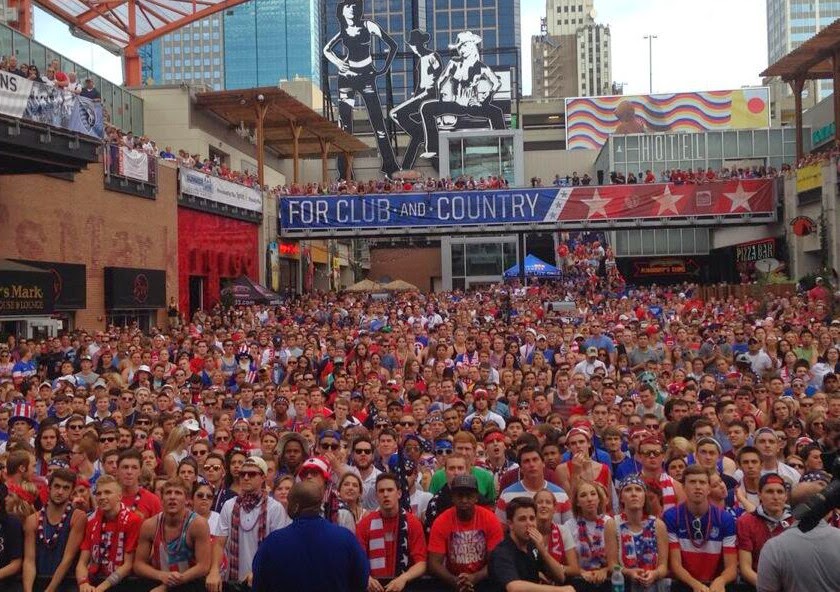
3) This fan base does not particularly care whether the USA has the best national team in the world.

Waiting for the US-Germany match at Power & Light District in KC

Check that: they do want to have the best team in the world, but they know it's not there yet and are hanging on anyway.
Here's where a lot of people get a bit mystified.  We are virtually the only country in the world where American football (you know, the one with the pads and CTE) is played.  Baseball might just be more popular in the Caribbean, Korea, or Japan than it is in the US by now, and it's making surprising headway in Europe, but despite somehow failing to win the World Baseball Classic so far, most would agree that the gravitational center of the sport is still here.  Basketball is about as "American" as a sport can get, in that we actually can point to a place and date and person for its invention in this country; that said, the moment US teams started getting beat at the Olympics we suddenly found it convenient to release NBA stars to play there, insuring that we won't lose another Olympics for quite a while.
We're not winning the World Cup any time soon.  Even the coach gets this.  The US team is certainly better than it's been in a long time and seems to be improving tremendously in recent years, but put us in a regular rotation with Brazil, Argentina, Germany, etc. at their best and we're going to take our beatings.  This does not bother soccer fans in the US, many of whom (traitorous pigs that they are) openly root for other countries, and others of whom get that the US has a long ways to go and are in for the long haul (I place myself here, for what it's worth).
This kind of thing infuriates some people.  They are baffled and angered when thousands of people gather in large public spaces in Chicago or Kansas City or other oh-so-American cities and live and die with each cross or header or save.  That's not American.  What's wrong with them?  
I could (and may yet) write a huge number of posts about the ethical failings of the World Cup and its overseer organization FIFA (an exercise in shooting fish in a barrel, to be sure): the feckless waste of resources on stadiums that will go unused after the Cup is gone; the deplorable state of Brazilian infrastructure ignored in the quest to put up said stadiums; the complicity of ESPN and like media in steadfastly pretending these things are not true and that many Brazilians have not protested these things, just to name a few.  Still, there is something stunning about the way that the sport and its banner event have managed to wear down American resistance and carve out a pretty substantial swath of allegiance and impact not just within my lifetime, but within my adult lifetime.  It's a different demographic, with different ideas about how the world works and a decided lack of interest in perpetuating old stereotypes and rules.
Of course this is going to tick some people off.

Wednesday, April 30, 2014

Sterling, Silver, Tarnish

Wow, so many possible subjects to blog upon.  The most obvious one, and most current, wins out though.
So the NBA has grabbed not only sports headlines, but news thunder as well.  The owner of the Los Angeles Clippers, a longtime scumbag named (or renamed) Donald Sterling, was handed a lifetime ban from the NBA along with a $2.5M fine, and NBA commissioner Adam Silver also let it be known he would seek from the rest of the NBA's owners a move to force Sterling to divest himself of the team altogether.
There has been enough comment on this to choke a herd of elephants, but I will try to add a small amount of worthwhile stuff to the fire.

Dude has another business, you know.

1) The description of Sterling above as "longtime scumbag" is not accidental.  If you've followed this story much you've learned, if you didn't already know, that Sterling has had legal issues as a landlord/slumlord, including federal suits that were either dropped or "settled," i.e. bought off, hinging on discriminatory practices by Sterling against various minority groups.
This has begged the question: why were those explicit examples of raging bigotry not important enough to provoke action from the NBA, but these most recent words set the world on fire?
This isn't a unique spot.  I can't help but recall the Chick-fil-A kerfuffle from a few years ago; Chick-fil-A had been giving plenty of money to anti-gay groups for some years before head honcho Dan Cathy made some impolitic remarks to a reporter, but large-scale outrage didn't get going until that interview got published.  It would appear that actions do not, in fact, speak louder than words.
Some caveats: a) Adam Silver is a new commissioner, so we can't necessarily assume Silver wouldn't have acted differently in the past, or that former commissioner David Stern would have acted the same way as Silver has in this situation; b) this is a different NBA than a few years ago -- whereas Michael Jordan didn't dare speak out on anything lest his advertising revenue get dinged, current players are more likely to voice opinions even in non-basketball matters, as witness the LeBron James-led Miami Heat hoodie protest in the wake of the Trayvon Martin murder.  To a great degree the NBA has far outstripped the NBA, NHL, and (as much as it pains me to say) MLB, which Jackie Robinson might not even recognize anymore.  (I would contend that MLS may well be near the NBA in terms of the overall progressiveness of its players and management, which would set it apart not only from its fellow American major leagues but especially from its European counterparts.)

2) Embarrassing ownership isn't new; ask anyone who remembers Marge Schott with the Cincinnati Reds.  That ended up being a difficult, drawn-out spectacle for MLB, but ultimately the owner, prone to say embarrassing things about her players and unpleasantly nice things about the Nazis, was eased out of the game.  The swiftness + severity of the NBA's action is the new thing here, and it is striking indeed.

3) As usual, a great deal of confusion about the First Amendment has followed in the wake of this action.  As far as I know, Sterling will continue to have the right to vote in federal, state, and local elections, and can continue to express repugnant opinions to anyone he chooses (although he might want to be more alert to the presence of recording devices).  The NBA, which like most sports leagues exists in a murky realm between business conglomerate and private club, is free (even more so than most leagues, so specific is its governing document) to take action against any owner who brings harm to the league, including removal if need be.  Considering the degree to which American courts have been ratcheting up corporate power over employees of late, saying that Sterling somehow got jobbed is a raging act of hypocrisy unless you're basically picketing the Supreme Court daily on behalf of less oppression of workers.

4) All of this happened during the NBA's playoffs, which would be an excuse for most leagues to sweep it all under the rug until after the finals (or longer if possible).  I haven't followed the NBA in years, not since Dominique Wilkins left the Atlanta Hawks (save for a short period around the Miami Heat's first (pre-LeBron) NBA championship, when I was living in West Palm Beach), and yet I found myself drawn to a Pacers-Hawks playoff game in the airport the other day, before all the Sterling mess had really hit.  That this all got settled before it had the chance to become a festering boil on the league's showcase event makes it yet again more impressive.

5) The NBA, by a large margin, includes more African-American athletes by percentage than its other major-league sports.  One suspects that another league would not have reacted so swiftly and decisively (it's impossible to conceive of the fossil known as Bud Selig doing anything decisively in MLB), again with the possible exception of MLS.  But then, we don't know that for sure.

All in all, it's a mixed bag at the moment.  While there is some satisfaction on seeing action taken, it's still hard to stomach that this particular scumbag's actions over the course of decades -- actions that directly made people's lives worse -- weren't enough to draw a peep from the NBA.  People could not get housing, or were harassed about their race or ethnic origin for decades -- not powerful people, but folks who don't have a lot of other people in their corner.  While I appreciate that Magic Johnson's feelings were probably hurt by Sterling's words, there is no way Johnson was as hurt by Sterling's words as any number of tenants in Sterling's slum dwellings.  Yet our hearts bleed for Johnson, or Chris Paul or Blake Griffin, but we pretend those black and Mexican and Korean tenants don't exist, much less that their plight is worth our concern.
The least of these, folks.  These are the ones Jesus wanted us to be concerned about and to speak for because their voices were not heard.  I'm pretty sure that Magic Johnson can take care of himself.  Chris Paul and Blake Griffin and others have a certain amount of clout themselves; even a hint of a game boycott had the potential to bring the league to its knees.  We're ready to rally against Sterling because of words, but he and his ilk can practice raging injustice with impunity, at the cost of a few million dollars at worst -- chump change to his like -- and we yawn if we react at all.
I can't help but think this incident, even it has come to a far more satisfactory ending than most thought possible, points again to one of our worst practices where sport and faith again fail to intersect, or perhaps intersect in the wrong way.  Where is our outrage, and why does it show up in places where it's not inappropriate, but perhaps not as needed, and fail to show up where it is absolutely needed and where Jesus demands that it appear?
It's hard not to conclude (in a phrase that could probably be appended to every entry on this blog) that sports matters too much.

Sunday, March 9, 2014

Stadiums, race codes, and cold hard cash, part II: the Richmond dilemma

Back in November, I used a column to go off on the Atlanta Cobb County Braves' plans to ditch Turner Field and decamp to the suburbs as indicated in the snark above.  There were financial issues, there were race issues, there were urban/suburban issues, there were environmental issues.  Indeed that whole story was quite a feast of issues.

Atlanta is hardly the only city to face questions about stadiums and their upkeep and financing.  Perhaps the most notorious fleece job of late was down in Miami, where the Miami-Dade municipality ended up on the hook for the bulk of the cost of Marlins Park, to the point that some elected officials quickly found themselves no-longer-elected officials.  But there are other examples -- the Yankees sticking NYC with the tab for the current, bloated iteration of Yankee Stadium, and the Mets doing likewise with Citi Field or whatever it's called now; the bizarre spectacle of Los Angeles, the second largest city in the US, not having an NFL franchise despite two venerable stadiums (and former Super Bowl hosts) in the greater metro area; the heist that transformed the Seattle SuperSonics into the Oklahoma City Thunder; and so forth.

One doesn't hear about these kinds of kerfuffles when it comes to non-major-league sports, but the issues don't necessarily avoid the minor leagues.  Here in my current location, Richmond is undergoing a protracted stew over the proposed replacement of The Diamond, a 70s-vintage stadium built for the Braves' AAA franchise of the day.  The R-Braves hotfooted out of Richmond for the Atlanta suburbs some years ago, and after some wanderings in the baseball-less desert the city finally attracted a new tenant in the form of the San Francisco Giants' AA franchise, which had been somewhere in Connecticut previously.

The team, renamed the Richmond Flying Squirrels (I kid you not), has played in The Diamond since 2010, and has, to quote the Richmond Times-Dispatch, "become a regional asset that enjoys the public's affections to an extent the R-Braves did not."  The management of the franchise has worked hard to be an attractive and good neighbor in the city, offering the over-the-top in-game attractions typical of many minor-league teams, the kind that are so prolific that you (not me, specifically, but perhaps some of you) might even forget a game is going on.  They've made good connections with local businesses, sponsored activities outside baseball season to benefit the community, and generally hit all the right marketing and community-relations buttons during its tenure here.

There is one small issue, though, on which the organization has, even before relocating to Richmond, been unequivocal: The Diamond had to be replaced.

The Diamond, exterior (right field/first base side)

To put it kindly, The Diamond is an odd duck of a stadium.  From a distance it can look a bit like a UFO broke apart in midair and half of it landed here.  For a minor-league stadium it feels huge, even though it isn't necessarily all that big, I guess.  

Aerial view of the Diamond, with a team logo cut into center field.

As the above picture shows, while the stands feel a bit ginormous, the only extend a small stretch beyond first and third bases, and there is no outfield seating.  It is basically surrounded by its own parking lot, and as the picture suggests, the stadium hasn't necessarily gotten surrounded by a lot of commercial development on its street, The Boulevard (clever names seem to abound).  To be honest, that stretch of The Boulevard is a little bleak.

Hey, who turned out the lights?  This has happened more than once.

To put it a bit more bluntly, The Diamond has seen better days.  I don't know if it's an issue of upkeep, or if what worked in the 70s was a bit shortsighted, or what the issue is, but the best I can say of it as a place to watch a ball game is "it's okay."  Concourses for getting around the stadium are a bit cramped, the bathrooms need help badly, the concessions facilities struggle with large crowds, and the sight lines from the stands are fairly bad unless you're directly behind home plate.  

Apparently the parts of the stadium not populated by fans have bigger issues.  A substantial chunk of the left-field fence was taken out in a strong thunderstorm back in 2012.  The clubhouses for both home and visiting teams apparently flood easily in any kind of non-trivial rain.  And as the previous picture suggests, the power goes out a bit too easily for a large facility that tends to be highly occupied. 


Lookit the crowds! Lookit the crowds!

The Squirrels draw well.  They tend to be at or near the top of the Eastern League in attendance (admittedly, The Diamond is a bit bigger than most of the stadiums in the league, having been built for a AAA team), thanks mostly to the tireless promotional efforts of their front office.  They may in fact be undermining their efforts towards a new ballpark by being so good at their jobs.  When so many show up so readily for the big concrete thing, it's hard to persuade those so many that something better (and probably not bigger) is needed.  Perhaps inviting fans into the flooding clubhouse during the next rain delay might help.

Not everybody is so easily swayed, however.  A certain level of irritation is evidently settling in with the Flying Squirrels management (though they're far too savvy to show it in public), the parent Giants, and the Eastern League, whose president invoked the specter of a "Richmond Braves sequel" in a statement last December.  That statement, along with one from the president of Minor League Baseball (also included in that last link), seems to have prompted some movement.  The mayor of Richmond came forward with a plan for a ballpark/development plan that would move the team from that location on The Boulevard to a part of the city known as Shockoe Bottom.

One rendering of the proposed Shockoe Bottom development.

Shockoe Bottom and Shockoe Slip are two different sectors of Richmond down by the James River.  While Shockoe Slip has started to flourish as a business and nightlife location, the Bottom (cut off from the Slip by I-95) has seen spottier development.  There are some businesses and other organizations there (full disclosure: the office of the organization for which I am doing my internship this year is located in Shockoe Bottom), and it does have some of the best restaurants in Richmond, increasingly a foodie town.  It also has a lot of vacant buildings.  

It also has a microcosm of the history of slavery in the United States.  

Shockoe Bottom was the site of the second-largest antebellum slave market in the United States (after one in New Orleans).  Almost seventy slave dealers and auction houses dotted the district.  Also found in Shockoe Bottom were Lumpkin's Jail, a slave jail, and a large burial ground.  Some active excavation is still underway in the area, and exact locations of these facilities can be hard to pin down in some cases.  

Hence building much of anything in Shockoe Bottom is fraught with complications and heated passions.  There are factions who find Shockoe Bottom unendurable in its present state and badly in need of redevelopment.  There are those who are vocally insistent that any kind of redevelopment is equivalent to desecration.  And there are probably hundreds of positions in between.

The mayor's plan would include all sorts of other stuff besides the stadium in the Bottom: a grocery store and other retail locations, and of course plentiful nightlife options.  Most notable is a plan to build a long-awaited slavery memorial of some sort as part of the project.  In the meantime, The Diamond's location on The Boulevard would also be targeted for commercial development (a tacit admission that stadiums don't automatically bring a neighborhood redevelopment), probably as a sop to the building of a training-camp site for the Washington NFL franchise that first operated this past summer and an attempt to generate more commercial traffic for that site that functions for about six weeks a year.  

The mayor and council have made a few road trips in the course of developing a plan, including to Denver and Coors Field, one of the few fairly successful redevelopment plans with a stadium involved, and Durham, NC, a minor-league town that had its own struggles in replacing an aging park.  A local columnist suggests they should visit Tulsa, OK, which faced a somewhat similar situation in building a ballpark on the site of the 1921 Tulsa Race Riot.  

A series of public meetings have been held on the project, marked mostly by heated accusations and recriminations and a general lack of listening.  (At this point it's probably best to refer you to the Times-Dispatch's coverage of the ballpark issue.  The T-D is far from my favorite paper, but it has generally been decent at covering this story.)  The mayor, once roused to action by the aforementioned grumblings from the Eastern League and Minor League Baseball, has been relatively resolute in pushing the new plan, and a fairly aggressive public-relations campaign has simultaneously been pushing the concept.  (That sprang up in Shockoe Bottom pretty quickly; I showed up for work one day and there were signs all over the Bottom.)  

And there the situation sits.  

If you're expecting a fully formed answer out of me on this one, you're going to be disappointed.  I'm torn, and in many ways not totally invested as I hope to be moving away from Richmond some time in the reasonably near future.  But it is a disturbing situation that touches on many things I care about, and I can't totally ignore it.

So, a few thoughts:

1. That there has not yet been any kind of slavery memorial or museum or anything done in Richmond (capital of the Confederacy, remember) is bizarre and repulsive.  You can find about sixty million Civil War museums or memorials around here, including the infamous Monument Avenue statues of Robert E. Lee, Jeb Stuart, "Stonewall" Jackson and other Civil War figures (along with tennis star Arthur Ashe, incongruously).  There's a Holocaust museum.  There are sites related to the Revolutionary War era, and some dating back to the 1600s.  Aside from the Lumpkin's Jail site and one statue marking Richmond as a corner of the "slave triangle" slavery in Richmond is kept largely hush-hush.  That's nuts, and wrong.  If this redevelopment finally pushes along the establishment of some kind of memorial, it deserves not to be dismissed out of hand.

2. There is a lot of unknown, as indicated before, about where exactly everything was in Shockoe Bottom.  It's probably not a great idea that home plate or the pitcher's mound end up smack on top of a major slave cemetery.  Is there not a way to get some greater clarity about the Bottom before rushing into the project?

3. Shockoe Bottom is near the James River and I-95.  What about traffic off that interstate (already rather snarled on frequent occasions) or flooding?  I'm sure these have to be addressed in any such plan.  As I railed about the environmental horror of the Braves' plans in Cobb County, so I'll want to see that this isn't going to create a similar emissions nightmare for Richmond (obviously, the number of cars is going to be a bit smaller).  

4. In the mayor's and council's travels, I wish they had bothered to visit the Negro Leagues Baseball Museum in Kansas City.  It is the cite without peer for getting an understanding of baseball and race in America.  Far from being confined to the famous Negro Leagues of the 30s and 40s, the museum tracks a long history of baseball and the African-American experience and their frequent intertwining. The Richmond folk should visit for two reasons.  One, this is the place to learn how to make baseball and history work together.  Baseball is about the only sport that could possibly be moved into Shockoe Bottom and work in harmony with the history/memorial project that has to happen there.  Baseball's history is long, and may well have intersected with the lives of slaves -- it certainly was played among free blacks in various locations, and games similar to baseball are recounted in stories of slave life.  Its intersection with African-American life after slavery is much easier to trace.  (Side note: your homework assignment is to go to the Negro Leagues Baseball Museum if you're ever in Kansas City, along with the National World War I Museum at Liberty Memorial.)  

In short, baseball is uniquely suitable to be the sport in this situation.  (If basketball's history went any further back than 1904, it might have worked.)  If a stadium is going to be built in Shockoe Bottom, it better be a ballpark.  (And it better be named for Ray Dandridge.)  

5. A stadium does not have to be built in Shockoe Bottom.  They aren't magic bullets for development.  The pairing of sports facilities and memorial/museum sites is actually not without precedent; in Cincinnati, the National Underground Railroad Freedom Center, with its related story, sits nestled in between Paul Brown Stadium (Bengals) and the Great American Ballpark (Reds).  But you have to explain why it works, and how the ballpark will honor and serve the memorial/museum and the story that must be told (and avoid dishonoring site and story).  But being able to do that takes time and research and commitment.  And I don't know if anybody in the city or with the Squirrels is able or willing to do that.  

The Great American Ballpark, as seen from the National Underground Railroad Freedom Center

Some people will recoil at the thought of building so frivolous as a ballpark on what they view (and think everybody should view) as sacred or sacralized ground.  If you want to go forward, you have to take those claims seriously and make the case that it is not frivolous.  Baseball does offer a unique opportunity to do that, but it takes work.

6. On the money issue: I cannot make the case that municipalities should never spend money on sports facilities.  I kinda wish I could, but I have this problem: I like symphony orchestras.  I like history.  I like art.  And the facilities that house such things -- concert halls, museums, galleries and such -- tend not to happen without some sort of public participation.  And if I like my concert halls and museums, I'm not in the position to deny a ballpark to those who like having that available (admittedly, that number does include me too).  (And yes, there are plenty of folk who would call concert halls and such frivolous, on the brilliant reasoning that "if I don't like it, it's frivolous" -- don't be that person, folks, about either one.)

I can, however, say that no municipality should ever foot the total bill for said sports facility.  The Squirrels have indicated they will pay part of the cost in this case, though the exact proportions are not clear.  And I can say that a municipality with a 35% poverty rate should not be throwing wads of money around for a stadium without first addressing that poverty rate (looking at you, Richmond).  And please don't try to convince me that the whole redevelopment plan is going to fix that.  Developers are not particularly charitable.  

In short (too late!), I think a Shockoe Bottom stadium can make sense, and even be useful in doing a profoundly good thing and righting an injustice (something always theologically in favor).  But it takes time and careful thought and foresight, whereas in Richmond neither seems to be readily available.  This kind of process should probably have started the first time Shockoe Bottom was proposed as a ballpark site, several years ago; I see no evidence that it was.  

Of course there is time pressure; the Squirrels (along with the Giants, Eastern League, and MiLB) are getting restless, and too much more delay might provoke Nutzy the Flying Squirrel mascot to throw up his hands and stick out his thumb on I-95 or I-64 and hitch a ride to a municipality with its act together (or a bigger sucker, whichever you prefer).  But doing it right, in a way that hears all voices and respects and honors the horror and tragedy in Shockoe Bottom's history, can't be achieved by shortcut.  In a way maybe it's fitting that sports entertainment should "earn its keep" by putting itself at the service of something larger than one team, by being a servant to history and the public good.  I just wonder if anybody in Richmond has that kind of vision.

Note: the image used as the background for this blog is from one of my frequent trips to The Diamond for a Flying Squirrels game, from my usual general admission seating choice behind home plate.