Showing posts with label World Cup. Show all posts

Thursday, April 21, 2016

Spectacle and harm

You might have heard that Prince Rogers Nelson, or the artist formerly known as The Artist Formerly Known as Prince, died today.

The iconic and iconoclastic singer/guitarist/songwriter/cultural lightning rod was found dead today in an elevator (wasn't that somehow part of "Let's Go Crazy"?) at his home/recording studio/complex in Minnesota. In a year with entirely too many musicians slipping off this mortal coil, this one was a cannon shot to the solar plexus for those of us of a particular age.

Prince wasn't without his affections for sports, especially for his Minnesota-based teams. He once wrote a song for the NFL's Minnesota Vikings, took in the NBA's Timberwolves, and threw was has been called an epic concert for the WNBA's Minnesota Lynx after they won their league championship.

But perhaps his most indelible mark in the sporting world was his performance for the halftime show of Super Bowl XLI, in Miami in 2007.* This was the Super Bowl that was unique for more than its particular combination of Roman numerals; it was the one Super Bowl that got rained on, pretty much for the whole game.

*Corrected; originally "2012" -- apparently I can't do Roman numerals anymore.

In this story (from The Weather Channel...well, he did sing about purple rain) the story is told of Prince's reaction when NFL foofs checked the weather that morning and folks in charge of the halftime show reported the rain to Prince. His epic reaction: "Can you make it rain harder?"

He of course proceeded to go out and blow the Super Bowl away, rain-slickened stage and all.

What is interesting, in watching the event all these years later, is how little Prince particularly cares to be part of the NFL's spectacle; Prince was a spectacle all by himself, and that year the NFL was fortunate to tag along with a performer for whom a downpour was just an interesting stage effect.

But Prince at the Super Bowl does raise some interesting points about the spectacle that attaches itself to the Super Bowl and other major sporting events (and indeed, to almost all professional and major-college sporting events to some degree). The very idea of a halftime show at a football game points to the degree to which some kind of spectacle has attached itself to that particular game for a very long time. (It might be worth the recollection that, throughout high school and my first two years of college, I was part of that spectacle -- a band geek.)

If you think about it, that's a little bit different from other sports. Most sporting events anymore begin with the national anthem -- a bit of patriotic spectacle, if you will -- but, unless you're in the playoffs, that's about it for a baseball game (unless you count "Take Me Out To the Ballgame" as a kind of spectacle; I could see it, but I think of it as something different.) Basketball games, on the major-college level at least, are increasingly offering some sort of halftime entertainment, which might vary from some sort of musical performer to a juggler or tumbling act or aerial acrobatics -- what might have been called "sideshow entertainment" in the past. Having not been to an NBA game I can't comment on what happens there.

The longstanding tradition of halftime spectacle, though, seems fairly unique to football. This I suppose is fairly sensible, since of the most popular sports going today football has the most in common with the kind of sporting event that used to be called "spectacle."

Yes, kids, it's time to bring in the good ol' Roman Empire and its "spectacles."

I have remarked in previous blog entries on the relative lack of sustained development of theological consideration of the ongoing saga of brain trauma and football; one partial exception is discussed here, and Dr. Hoffman's book is among a rather larger (though still not huge) body of literature that takes on the subject of Christianity and sports more generally. One of the inevitable tropes that appear in such literature is the games and sports of the Roman Empire, events to which are frequently attached the term "spectacle." This emphasizes, beyond the simple physical brutality of the contests (includiating gladiatorial combats and chariot races), the degree to which extra-sporting events accrued around the sporting contests. Of course, in the case of Rome, it might in some cases be that the sporting contests wormed their way into the specacle.

At times the spectacle was overtly religious, in the context of the Roman Empire and its pantheon of deities. Multiple such deities might have been appeased or honored in the ceremonies surrounding the contests, and of course the emperor or any representative of the emperor could expect his own share of adulation as well. (Looking slightly further back in history, much the same would have held true of the Athenian spectacles surrounding the original Olympic Games.)

Of course, the contests themselves were much more immediately harmful to their competitors, and in some cases much more immediately fatal, depending on the whim of the emperor or crowd. Though there are exceptions, we do not expect our competitors to die in front of us at sporting events we attend, and when it does happen the sporting entity in question goes through all manner of soul-searching and procedural review. Even an organization like NASCAR erupts in a paroxysm of new safety measures and guidelines in the wake of a death or major injury on the track (although, with the sometimes highly personal affection for the competitors in that more individual sport, perhaps that's not so surprising).

Nowadays, the adulation of "idols" surrounding our sporting events is rather more discreet as well. While a great deal of adulation seems to be directed at God by some athletes on or immediately off the field, it's not always certain how much that adulation is actually directed at the God revealed in the crucified Christ, the Man of Sorrows, the Prince of Peace. (But that's a discussion for another book, some of which have already been written -- but that's another blog post.) There are plenty of other idols surrounding our sporting events, though, if you look hard enough.

One might think of the corporate sponsors, who now generally have their names spashed on everythign from the stadium itself to the timeouts, not to mention in signs all over the place. (I once went to a minor-league baseball game where the strikeouts were "sponsored by Circle K"; funny, but if Circle K didn't pony up the dough were the pitchers not allowed to strike anybody out?) Perhaps the cheerleaders on the sidelines become objects of, uh, we'll call it "worship" for now although we know darn well it's anything but. The coaches increasingly become figures of a particular kind of adulation. Celebrities who appear in the stands (particularly in Fox baseball broadcasts) might fall in here.

Perhaps even the players themselves, or more specifically the bodies of the players themselves, become these objects of devotion. This is of course particularly ironic in the case of football or other sports in which intense physical damage or harm is the frequent (or possibly inevitable -- yes, that entry again) consequence of the action on the field.

One of the questions that is inevitable is: how much does the spectacle surrounding the game a cover for the destructiveness of the game itself on the bodies of those who play, or how much does the game seek cover in spectacle? Or does the spectacle seek to draw attention to itself by attaching itself to the game?

In this context it's interesting to go back to Prince's halftime show, and to remember why such shows became the norm. In case you don't remember, or you're a little too young to remember, you kinda have to blame Jim Carrey and Damon Wayans for that.

In 1992 Fox (not yet privileged to broadcast the Super Bowl, I guess?) went after the NFL's halftime activities (at that point the most frequent performer for SB halftimes was still the Grambling University marching band, I think, and Up With People was another common guest performer), counterprogramming a strange little halftime called "Winter Magic" with an episode of their sketch-comedy program "In Living Color," starring Carrey and Wayans and others. The counterpunch was effective enough to draw more viewers than the Super Bowl halftime show. (This after the previous year's halftime show had been pre-empted, at least on the air, by ABC News coverage of Operation Desert Storm.) The NFL was going to have none of that; the following year's halftime show featured no less than Michael Jackson, and such major acts has been the trend ever since (with a brief detour into former major acts after sister Janet's exposed nipple).

Clearly in that case spectacle became a means of propping up the game. Or is it that clear? After all, the audience that flipped the channel for "In Living Color" did seem to return to the game right afterwards. But incomplete or distracted adulation of idols apparently doesn't cut it; it seems you are required to stay for the whole worship service.

This is far from a complete survey of the relationship of sport and spectacle, and football is far from the only sport to indulge in it to some degree. (At some point we really need an examination or dissection of the crazy ceremonies that precede soccer matches, especially FIFA-sponsored contests.)  We're not far from another round of the modern Olympics, where sport and spectacle are joined at the hip. But the relationship of sport and spectacle in a sport still grappling with its frequently destructive tendencies towards its players can't be neglected in seeking to sort out the allegiances of those who continue to participate (as fans or supporters) in the game, or the spectacle, or in some combination of both.

RIP Prince. Regrettably, the rain was not purple that night.


Sunday, July 5, 2015

The many challenges of soccer

So the Women's World Cup final is approaching halftime at this point, and the main story so far has been the US blitzing out to four goals in the first sixteen minutes, only to have Japan pull one back and slow the US down in the last chunk of the half.

Despite a few oddities (like, how in the world did Germany and France end up playing each other in a quarterfinal -- more on that later -- and was that stadium in Edmonton ever full?), I dare say this will turn out to be a successful WWC. One can hope, with maybe some justification, that the impact will be such that more women and girls get opportunities to play, and maybe play professionally if they've got the stuff to do it, and maybe not go broke doing it. One can hope that maybe the National Women's Soccer League (yes, it does exist) will get some more fans at games.

But it would be dishonest to pass off soccer as the ideal sport for the ethically sensitive fan. There are, as is the case with any sport, reasons for concern -- some of them well-known, some less so. Just to review a few:

1) FIFA. Actually this could be one, two, three, and maybe four, and the general corruption of this world governing body of soccer complicates one's reactions to some of the other issues to be considered below. I'm not even bothering to provide links here; if you haven't heard about the US and Swiss investigations of that body (I mean, really; if the Swiss are investigating you...) and can't find out more with a quick Google search it's very unlikely you could find your way to this highly obscure blog. Just look up Sepp Blatter and prepare to gag a lot.

2) CTE. After football and hockey, it's very possible that soccer is the most susceptible sport to chronic traumatic encephalopathy. At last report two or possibly three soccer players, including a Brazilian World Cup star of the 1950s, have been confirmed as having CTE by the post-mortem exams that are as of yet the only way to confirm that condition with certainty.

Think about it; not just all the headers, but all the collisions. If someone had tried to convince you that soccer was not a contact sport, hopefully the World Cup has disabused you of that naive belief. Recall the particularly frightening collision between Germany's Alexandra Popp and the US's Morgan Brian in last Tuesday's semifinal. It illustrates both just how such violent collisions can happen in the game, and soccer's particular difficulty in dealing with the problem.

One of soccer's particular charms is the utter relentlessness of the clock; it stops for nothing. It is the un-baseball in that respect. But a perpetually running clock doesn't allow for a clear diagnosis of whether a player has suffered a concussion or not. Even in (American) football, the clock can at least be stopped and the injury at least has a chance to be assessed properly (even if it frequently is not). Also complicating matters are the substitution rules in top-level soccer; unlike American football, but like baseball, a player cannot return to the game once removed. Furthermore, in such games, only three substitutions are allowed at all. So you can see the potential trouble; you run the risk of removing a player only for her or him to be o.k. after all, or you play on "a man down," or playing 10-on-11, while the player's condition is evaluated (or for good if you've already used your subs).

So how to address this? Do you stop the clock? (Major League Soccer and some other leagues are already starting to try "hydration breaks" to deal with intense heat; Orlando City may never play a home game without hydration breaks. But the idea isn't as out of bounds as it might have been a few years ago.) Come up with a "concussion substitution" who can then be pulled if the stricken player turns out o.k.? Declare the player automatically out of the game? Any or all of the above may be considered, but before long soccer partisans will be sounding like American football fans complaining about "being soft" or changing the nature of the game.

And of course, looming over all of this is the hopelessly corrupt FIFA. Is an organization that thinks Qatar in August is ideal for the game's showcase event even remotely capable of thinking rationally about the health of its players? And how much do you, the person of faith who enjoys the game, want to invest yourself and potentially your money in that particular hope?

3) Fan -isms. Until the last few decades, if Americans knew much about soccer at all (aside from the heyday of the old NASL and the New York Cosmos with Pelé), it might well have been less about the game and more about the hooliganism of some of its European (mostly English) fans. Fan racism is also a potent poison in the European game; players such as Kevin-Prince Boateng, from Ghana, and Mario Balotelli, an Italian of African ancestry, have at times encountered a horrifying racism, frequently in Italy but potentially anywhere, that might make even the most hardened Southern Neo-Confederate blanch with horror. (Seriously, read that link above only if/when you have a strong stomach.)

So far, the US game seems remarkably free of such plague. I seriously doubt it is totally free, and it's possible the game here benefits from the relative lack of coverage it gets in US media. But by comparison to the Euro game, fan racism in the US seems a lot less, possibly because soccer in the US seems to draw far more diverse crowds than the other major sports. By "diverse" I mean not only drawing fans from different races, but having what might be called un-segregated crowds; whites not always only with whites, Asian not only with Asian, and so forth. Whites hanging out with blacks hanging out with Hispanics hanging out with Asians. Easily the most such diverse sporting event I've ever attended live was my one match at Sporting Park in Kansas City, the first MLS match played there. I don't know if that's the case all over the US -- I seriously doubt it -- but it stood out dramatically to me even in the midst of a rather exciting game in an extremely modern stadium.

Meanwhile, while homophobia also rears its ugly head on occasion in Europe, MLS not only welcomed Robbie Rogers back into the league, but practically begged him to return from his premature retirement in which he dealt with the ramifications of his coming out. While the NBA went into convulsions over Jason Collins's status, and the NFL nearly fell apart over Michael Sam (not to mention baseball's ongoing straight-only facade), Rogers has spent the last couple of years settling in with the LA Galaxy with amazingly little stir after his debut. Again, I would be shocked if he hadn't received a bit of hate mail, and the US media's continuing ignoring of a sport that now regularly puts more butts in seats than the NHL and NBA might again be benefitting the league in this case, but the sport seems to be going about its business with little fuss over the subject. Not to mention that the newly-crowned World Cup champions from the US have relied on Abby Wambach and Megan Rapinoe for several years now with marginal fuss, and even a certain amount of activism from Rapinoe.

Will an expanding fan base possibly bring more struggle with the -isms of human culture? Will geographical expansion do so? It's something to watch in the future.

This is just a scraping of the surface. I didn't even get around to the potential pitfalls of a sport so reliant on nationalism for much of its appeal and structure; player responsibility and the appearance of making allowances for poor behavior, with troubled goalie Hope Solo as Exhibit A; and the impact of any and all of these things on youth soccer and its continuing popularity.

While the US soccer governing body seems to have its head screwed on more or less cleanly, the overarching structure and its mind-boggling corruption will be incredibly challenging for the sport in its future. It will be virtually impossible for the mindful fan to continue forward without being ever more mindful of how the sport conducts itself in the face of those challenges, and how it adapts in its continuing growth in the United States.

"Non-contact sport"...yeah, right.

Monday, June 30, 2014

Ann Coulter may be on to something

Before I even start let's be clear: Ann Coulter is a troll.  She is humanity, allegedly, at its most venal and corrupt.  It is important for you to understand this to be my opinion of that person.
It is important for you to know that because that is exactly why I believe Coulter might be on to something when she somehow associates the rising popularity of soccer with increasing "moral decay" in the Good Ol' US of A.  (And you should know by now I will not link to that kind of garbage; I'm assuming you've probably heard of it already.)
Here's the deal: soccer actually does, in a way, buck several trends that have usually been associated with the more typical sporting passions that claim popularity in this country.  My evidence is purely experiential and anecdotal; I completely acknowledge this and make no claims for any kind of scientific veracity.  But I see what I see, and that is all I can do.
Around three years ago I went to the first MLS match at Sporting Park in Kansas City, Kansas (it still had the "Livestrong" name attached to it at that point; this was before Lance Armstrong's full and total flameout).  It was SRO.  The franchise had been playing nothing but road matches at that point for weeks (electing not to return to the minor-league baseball park that had previously been their home), and finally getting to cut the ribbon on their new grounds was both relief and windfall for the club.  The match, with the Chicago Fire, ended scoreless, despite several strong runs and crazy long passes and shots that juuuuuust missed.
I spent most of the match walking around, enjoying views not obstructed except for my lack of height (as well as a pretty decent barbecue spot) and generally being surprised by everything.  That experience also formed my first "well...huh" observation about soccer in these here United States:
1) It was the most diverse crowd I had ever seen at a major-league level sporting event, live or televised.
This is not to say that MLB or NFL crowds are lily-white; it is to say that the Sporting crowd defied that particular duality in its diversity.  I did not see any identifiably Native American folk in the crowd, but that's about all that was missing.  Remember, we're talking about Kansas City here, smack-in-the-middle Kansas City.  Where were these crowds at Royals games or Chiefs games?  Also important here is a secondary point:
1a) This diversity of people came to the match together, or at least met at Sporting Park and hung out together at the game.  Baseball games can be diverse, but mostly on a black-white axis and in a more segregated fashion, though not always so and certainly not by compulsion.  I am not smart enough to know whether this is mostly because more of the crowd at baseball games is comprised of family units or if something else is afoot, but such division is usually pretty easy to spot at MLB games, and never more so to me than when at an Atlanta Braves game at Turner Field a couple of months ago.
Possibly a related point:
2) The Sporting Park crowd was young.  I refer to young adults, not children with their parents.  (This was a late start, so I did not expect to see the latter, frankly.)  How much 1, 1a, and 2 relate to and intersect with each other I do not know, but there's something there.
(Note: I haven't been to any MLS matches since moving here, but I have caught a few matches of the local USLPro side Richmond Kickers, and the above points seem to hold at least somewhat in this case as well, allowing for the different demographics of the two cities.)
Stepping away from that Sporting Park eye-opener to another point of a more general nature:
3) This fan base does not particularly care whether the USA has the best national team in the world.

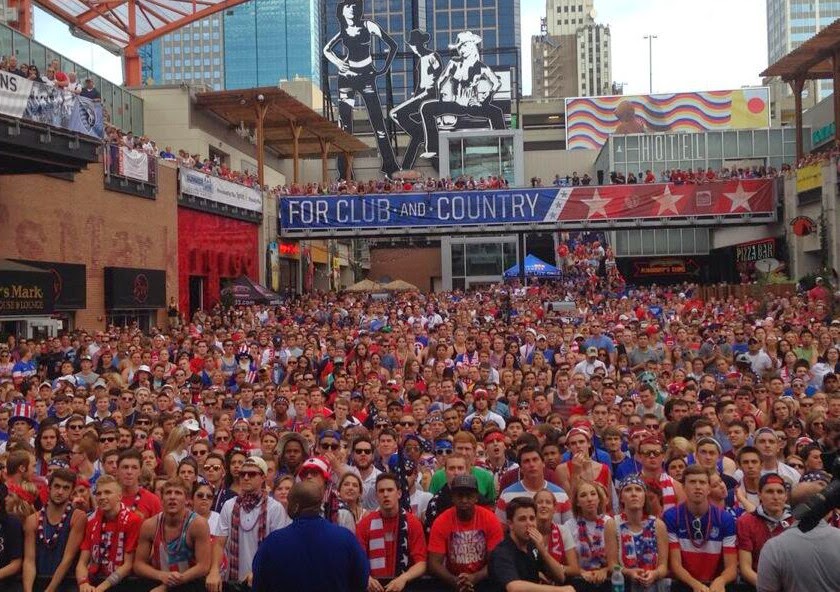
Waiting for the US-Germany match at Power & Light District in KC

Check that: they do want to have the best team in the world, but they know it's not there yet and are hanging on anyway.
Here's where a lot of people get a bit mystified.  We are virtually the only country in the world where American football (you know, the one with the pads and CTE) is played.  Baseball might just be more popular in the Caribbean, Korea, or Japan than it is in the US by now, and it's making surprising headway in Europe, but despite somehow failing to win the World Baseball Classic so far, most would agree that the gravitational center of the sport is still here.  Basketball is about as "American" as a sport can get, in that we actually can point to a place and date and person for its invention in this country; that said, the moment US teams started getting beat at the Olympics we suddenly found it convenient to release NBA stars to play there, insuring that we won't lose another Olympics for quite a while.
We're not winning the World Cup any time soon.  Even the coach gets this.  The US team is certainly better than it's been in a long time and seems to be improving tremendously in recent years, but put us in a regular rotation with Brazil, Argentina, Germany, etc. at their best and we're going to take our beatings.  This does not bother soccer fans in the US, many of whom (traitorous pigs that they are) openly root for other countries, and others of whom get that the US has a long ways to go and are in for the long haul (I place myself here, for what it's worth).
This kind of thing infuriates some people.  They are baffled and angered when thousands of people gather in large public spaces in Chicago or Kansas City or other oh-so-American cities and live and die with each cross or header or save.  That's not American.  What's wrong with them?  
I could (and may yet) write a huge number of posts about the ethical failings of the World Cup and its overseer organization FIFA (an exercise in shooting fish in a barrel, to be sure): the feckless waste of resources on stadiums that will go unused after the Cup is gone; the deplorable state of Brazilian infrastructure ignored in the quest to put up said stadiums; the complicity of ESPN and like media in steadfastly pretending these things are not true and that many Brazilians have not protested these things, just to name a few.  Still, there is something stunning about the way that the sport and its banner event have managed to wear down American resistance and carve out a pretty substantial swath of allegiance and impact not just within my lifetime, but within my adult lifetime.  It's a different demographic, with different ideas about how the world works and a decided lack of interest in perpetuating old stereotypes and rules.
Of course this is going to tick some people off.

Friday, January 17, 2014

Don't hate the player...hate the system

Aaron Rodgers's season ended much earlier than he hoped.  After a return from injury for the Green Bay Packers' final regular-season game -- a win that got the Packers a playoff spot -- he was unable to  pull off the first-round win against the San Francisco 49ers in the NFL's latest version of the Ice Bowl.

I'm certainly in no position to know what Aaron Rodgers does with his time in those first days after the season's over.  Rest, I'd guess.  But at least on occasion, it seems he uses such fame as he has for good things.

Rodgers has made appearances for an organization called Raise Hope for Congo, an organization that points to the desperate situation in that country in which what one might call "conflict minerals" are found (think "blood diamonds," but with items like tungsten, tin, tantalum -- materials for the manufacture of electronic devices, like your cell phone or maybe even the MacBook on which I'm typing out this blog industry).  Warlords, financing their war machines with profits from those minerals, using rape as a weapon of war; it's all there.  And Rodgers, who turned out to have a teammate from that troubled country, put his Cal education to use and studied up on the conflict, and now seeks to use that learning, and the fame that comes with being a Super Bowl-winning quarterback, to motivate college kids to do, well, something about it.

Good.


You didn't think the whole NFL was evil, did you?  (And before you ask, no, I didn't believe the whole NFL was evil, smarty pants.)

Rodgers is hardly the only pro athlete to use fame and/or fortune for good.  Clayton Kershaw, Los Angeles Dodgers pitcher, went so far as to establish an orphanage in Zambia with his wife, and to write, presumably with some help, a book about it (one which also gives expression to his faith).  For his charitable work Kershaw won baseball's Roberto Clemente Award, named in honor of the Pittsburgh Pirates outfielder and humanitarian who lost his life in a plane crash trying to deliver relief supplies to Nicaragua after an earthquake in late 1972.  The latter simply goes to the point that athletes doing good isn't a new thing.  Your favorite (or least favorite) player might just be doing that kind of good right now without your even knowing it.  

So there is all this good being done by people whom we pay money to watch play games.  Why, then, does someone like me feel compelled to tilt at the windmill of how sports cuts against the grain of serious faith all too often?  (As usual, I do feel compelled to point out when others with more audience than I seem to grasp this; I only wonder if #9 is too low.)  

For one, there are certainly bad apples in the games we watch -- the Richie Incognitos of the world -- and they often grab our attention.  But many of the most difficult problems that sports cause to the person of faith, those things that give pause no matter who much we don't want to watch, are not that easily attributable to the doings of any one individual or group of individuals.

C.S. Lewis, in one of his prefaces to The Screwtape Letters, offered the following take on how that book's concept of Hell took shape:

I live in the Managerial Age, in a world of Admin. The greatest evil is not now done in those sordid dens of crime that Dickens loved to paint. It is not done even in concentration camps and labour camps. In those we see its final result. But it is conceived and ordered (moved, seconded, carried, and minuted) in clean, carpeted, warmed, and well-lighted offices, by quiet men with white collars and cut fingernails and smooth-shaven cheeks who do not need to raise their voice. Hence, naturally enough, my symbol for Hell is something like the bureaucracy of a police state or the offices of a thoroughly nasty business concern.

Something probably akin to what Hanna Arendt called "the banality of evil," it points to the degree in which the evils of much of the twentieth century -- or those we see -- have their origins in hidden, 'clean' places like shabby offices or gleaming corporate towers.

I would also add that these sources may not even intend evil in the world.  

We see phrases such as "systemic evil" or "systems of oppression" used for this phenomenon in more contemporary times.  I would also submit that many of the most oppressive or degrading aspects of sports these days are also systemic.

Football locker rooms are intense places; keeping dozens of high-charged personalities in any sort of cohesive order is probably a task too tall for any one coach, maybe even for a whose staff, so the coach counts on team "leaders" to keep watch over the younger players.  So, when a bad apple manages to get himself counted among those "leaders," who's going to keep an eye on him?  

Or let's pick on baseball.  Some of the most outstanding talent in the game hails from one or another corner of the Caribbean, especially in the Dominican Republic.  With sometimes-inconsistent control of such things as birth certificates or other medical records, it becomes easy for a player, under the guidance/exploitation of a buscone, to present a false name and fake documents to MLB scouts (the younger the arm, the more valuable the prospect) in order to enhance his prospects for getting signed to a rich contract.  Hence Roberto Hernandez becomes Fausto Carmona; Juan Carlos Oviedo turns into Leo Nunez; and more.  That's if you're good enough to have a chance, and if you can withstand the culture shock of relocating from the DR to some small minor-league town that's colder than you can imagine.  If not, you just go back to your life, probably a poor one.

These are hardly the only examples.  Systems that drive you to lie about your condition when you've been found to have a concussion, so you can get back into the game -- even knowing what the world now knows about concussions; the college basketball phenomenon of the one-and-done player, loosely connected at most to any kind of academic endeavor; the corruption that has been known to seep into bidding for Olympic games or World Cups; name your favorite example.  


Systems seem to thrive on depersonalization; it's easier to ignore the mounting evidence of the damage football can (repeat: can) do to the human brain and send out a damaged player to resume play when he's a jersey number or position abbreviation instead of a person; when the kid in the DR is a sixteen-year-old with a 90-mph fastball instead of a person with a name; when people become simply cogs in a machine, before they are people.  

And therein lies the rub.  Where do we, the ticket-buyers, fit into the system?  

Let that one roll around in your head for a while.


Saturday, December 21, 2013

Ryan Freel and the sorting point

I have admitted, in this space and others, that I can't really watch football anymore.  I just can't.  I keep up, to some degree, and I know that my Ph.D. alma mater is in the alleged national championship game for college football's Football Bowl Subdivision, and that the NFL franchise in the nation's capital is having a rotten year, but actually sitting and watching a game is beyond me at this point, when all I can do is wonder how many years that hit took off a player's memory or cognitive function.

I have also admitted, in this space and others, that I'm a big baseball fan.

Therefore, specifically because I know my own biases, I am compelled to devote this column to the first confirmed case of chronic traumatic encephalopathy (CTE) in a Major League Baseball player.

Ryan Freel was a utility player.  He played for several teams, the Cincinnati Reds for six years and spent shorter terms with the Baltimore Orioles, Chicago Cubs, and Kansas City Royals.  According to his own account, he suffered "nine or ten" concussions across the course of his career, from being hit in the head by pitches or other thrown balls, from collisions with opponents, teammates, bases, walls, and all sorts of other things.  A sentence from the ESPN.com report linked above offers a pretty good description:

Freel showed no fear as he ran into walls, hurtled into the seats and crashed into other players trying to make catches. His jarring, diving grabs often made the highlight reels, and he was praised by those he played with and against for always having a dirt-stained uniform." 

He was the prototypical "scrappy" player, one who didn't necessarily have the natural gifts of other players but hustled relentlessly and played with reckless abandon, without regard for his own body -- a phrase which rings eerily prescient now, after Freel committed suicide one year ago Sunday (December 22).

Like so many football players after their careers ended, Freel's life after baseball was increasingly consumed, apparently, with symptoms like headaches, loss of attention or short-term memory, and swings from depression to explosive emotion, not to mention a family increasingly wondering what had happened to their son, husband, father.

Freel is somewhat of an atypical case for baseball.  While players hit in the head by pitched balls can and do suffer concussions -- Justin Morneau (now of the Colorado Rockies), Brian Roberts (just signed by the New York Yankees after years with the Orioles) and Corey Koskie (once of the Minnesota Twins, Toronto Blue Jays, and Milwaukee Brewers) are examples of players whose careers were derailed by concussion-related symptoms -- most of baseball's concussion-sufferers have been catchers.  Possibly the most well-known example is Mike Matheny, who actually had to retire from baseball due to ongoing symptoms.   Matheny may also offer some hope; he is now manager of the St. Louis Cardinals, taking that job five years after his retirement, and having pretty respectable success in it (the Cards made it to the World Series this year, in case you've forgotten).  Possibly the highest-profile catcher to see his career affected by concussion symptoms is Joe Mauer, the All-Star catcher of the Minnesota Twins, who is moving to first base next season (the position occupied by Justin Morneau, when health allowed, until he was traded this past season) in hopes of avoiding any more concussions.

Catchers are easily put in the most situations that might lead to concussions and their complications.  In addition to the risks any batter faces of taking a pitch to the head (rare, and frowned upon), catchers also face particular risks associated with the position they play.  When a fastball upwards of 90 mph (sometimes even 100 mph or more) tips just slightly off the bat of a major-league hitter, it is physically impossible for a catcher to react quickly enough to keep the ball from slamming into his face mask or helmet, if that's where it's headed.  More rarely, the end of a hitter's swing just might slam the bat into the catcher's helmet.  These are not intentional; they happen nonetheless.

More dubious is the home-plate collision.  If a runner happens to be approaching home plate at about the same time a throw is reaching the catcher in an attempt to get that runner out, a collision is a frequent result.  Sometimes a catcher is attempting to block the runner from the plate even though the ball hasn't arrived yet, sometimes the runner is attempting to knock the ball loose from the catcher's mitt or hand.  Either way, the result is typically the most violent play in baseball (though a few accidental collisions between fielders come close at times).  All the padding in the world can't necessarily stop the catcher from sustaining a head injury in that situation.

Of course, Major League Baseball, like its companion league the NFL, has taken a head-in-sand approach to the issue, moving to deny any responsibility for such injuries and claim that the problem is a distinctly minor . . .  .

Wait, what?  Actually (and amazingly), MLB has done quite the opposite.

Even before the results of the tests on Ryan Freel's brain were announced, MLB had already taken steps to cut out one of the major contributors to baseball head injury; the elimination of those home-plate collisions.  Already MLB had instituted a seven-day disabled list specifically for head injuries -- an opportunity for a player to recover without missing more time than might be necessary if the problem is diagnosed quickly and accurately.

This is frankly mind-blowing.  The same league that turned a blind eye to drug scandals in the 1980s and performance-enhancing drug use in the 1990s is actually being shockingly proactive.  MLB and its owners can be profoundly corrupt, whether it comes in the form of holding municipalities up for glossy new stadiums or ignoring some of the horrifying practices involved in the development and signing of baseball players from the Caribbean region.  In this case, though, there seems to be genuine sorrow when a player like Matheny has to retire, a sorrow which in this case seems to be prompting genuine and surprising willingness to address the problem, even if the rules of the game are affected.


One of my least favorite parables in the Gospels is the so-called parable of the sheep and the goats, Matthew 25:31-46.  It is probably familiar to most folks with much church experience at all; the nations are gathered before the Son of Man, who separates them as a shepherd separates sheep from goats, sheep to the right and goats to the left.  The Son of Man then praises those on the right (who are now not sheep but "the righteous") for their responses to him when he was in need; feeding the hungry, clothing those with no clothes, visiting the sick or imprisoned.  Those on the left, the "accursed," are upbraided and even cast away, for exactly their failure to do those things the righteous did.  In each case, the rationale is offered that what you did to "the least of these," you did to Christ.

To me, what has lately jumped out at me about this passage (a troublesome one to me and others) is that, even as a sorting is portrayed at the beginning of the story, the "righteous" and the "accursed" had actually "sorted" themselves well before coming before Christ, by their actions towards those they encountered in need.  They fed hungry people or didn't.  How we respond to needs, to crises, to harms, to injustices in the world matters.  Those responses reveal us.  Further, they shape us -- ignoring one injustice or one need makes it easier to ignore the next one.

Grantland writer Brian Phillips penned a column this week pointing towards the particular quality of the sporting year 2013 as one in which the fan's increasing and unavoidable awareness of the corruptions of sports (the CTE horrors of the NFL being only one of many addressed) somehow failed to intersect or connect with the sports watching experience.  Baseball had a frankly amazing season, even as the Biogenesis scandal unfolded; the NFL continues to thrive even as the increasing tide of CTE stories vies with murder, bullying, and who knows what else conspire to stain the sport; worldwide soccer is as huge as ever even as it becomes clear that next year's World Cup will take place in a deeply dysfunctional (and yes, fatal) atmosphere.  Somehow fans simply keep the two separate.  Fans do care, Phillips claims, about CTE and match-fixing and murders and suicides and murder-suicides, but kept watching as if unaffected.

To which I have to ask, how long?  How long can the two be held apart from one another?  How long can the two go on, coexisting, before the fan sorts himself or herself in among the sheep or goats?  Another scripture, Matthew 6:24, points out that serving two masters doesn't work out so well.  You end up serving one or the other.

Eventually a fan will serve one master or another; his or her attentions (and dollars, the stuff that actually hits sporting leagues or players where it hurts) will turn away from unrepentant exploitation in sports towards other pursuits, or he or she will keep on watching, less and less fazed by the mounting toll in bodies or brains or children in poverty in the shadow of flashy new stadiums.

I can't help but wonder if we -- not just the NFL or MLB or FIFA or whatever league you care to name, but we -- the people who put down the money to buy tickets or subscribe to cable to get ESPN in its various guises, or buy the merchandise or devote eight Sundays or six or seven Saturdays to tailgating, who buy product X because King James endorses it instead of product Y endorsed by Kobe Bryant, we -- are at a sorting point, slowly aligning ourselves with the sheep or the goats when it comes to the excesses and the abuses that are intricately bound up in the sports-fan experience.

This may require people of faith to make a leap many are not willing to make: to realize that one who may be an exploiter in one circumstance may well be the exploited in another.  For example: male athletes have, to put it mildly, a reputation as being sexually active, taking on groupies for pleasure (witness the claims that the late Wilt Chamberlain bedded at least 2,000 women in his lifetime).  An athlete who buys a prostitute? Clearly not paying attention to the women waiting in the hotel lobby.  By no means does every athlete do so, but many do.  When you're on the road, have plenty of money to blow, and plenty of women to enjoy, it's easy to do both.

Exploitative behavior?  Sure.  But does that make the athlete any less the exploited party when, after years of his league telling him concussions were no big deal, his brain ends up on an examining table in Boston or Pittsburgh?  I don't think so.  What are those millions of dollars (if they haven't been squandered by then) worth in that case?

Athletes are at a sorting point, too.  Are NFL or NCAA players going to stand by and continue to participate in their own brain damage?  Just how much are major-league baseball players willing to pump themselves full of chemicals in pursuit of a competitive advantage?

The tricky part is, one of the options requires an active choice.  You have to choose to walk away from your sporting passions, or at least to scream like Howard Beale in Network.  If you don't, you eventually go numb.  Of course, you can choose to let the corruptions pass unobserved, and go numb voluntarily.

Either way, you will go numb, eventually, unless you choose not to.


Saturday, December 14, 2013

Way more important than what?

A headlines roundup/linkfest in rant form:

/rant begins/

Back in the first entry on this blog I made reference to the saying back where I come from, "Football ain't a religion.  It's way more important than that," from which this blog takes its name.

Of late I find myself wondering about sports, "Way more important than what?"

The headlines have asked the question: more important than having a functional mind and body when your playing days are over?

More important than getting through high school?

More important than getting out of a game alive, even if you're not playing?

More important than having a functional country?

More important than being yourself?

More important than not being jerks to a people who've already experienced plenty of jerkishness?

More important than basic functional decency to loyal (and successful) people?

More important than basically getting legal justice right? (Don't assume I'm on "your side" here.  I think all sides have royally f***ed this one up, pun intended.)

More important than, basically, life?


/rant ends/

/for now/