Monday, June 30, 2014

Ann Coulter may be on to something

Before I even start let's be clear: Ann Coulter is a troll.  She is humanity, allegedly, at its most venal and corrupt.  It is important for you to understand this to be my opinion of that person.
It is important for you to know that because that is exactly why I believe Coulter might be on to something when she somehow associates the rising popularity of soccer with increasing "moral decay" in the Good Ol' US of A.  (And you should know by now I will not link to that kind of garbage; I'm assuming you've probably heard of it already.)
Here's the deal: soccer actually does, in a way, buck several trends that have usually been associated with the more typical sporting passions that claim popularity in this country.  My evidence is purely experiential and anecdotal; I completely acknowledge this and make no claims for any kind of scientific veracity.  But I see what I see, and that is all I can do.
Around three years ago I went to the first MLS match at Sporting Park in Kansas City, Kansas (it still had the "Livestrong" name attached to it at that point; this was before Lance Armstrong's full and total flameout).  It was SRO.  The franchise had been playing nothing but road matches at that point for weeks (electing not to return to the minor-league baseball park that had previously been their home), and finally getting to cut the ribbon on their new grounds was both relief and windfall for the club.  The match, with the Chicago Fire, ended scoreless, despite several strong runs and crazy long passes and shots that juuuuuust missed.
I spent most of the match walking around, enjoying views not obstructed except for my lack of height (as well as a pretty decent barbecue spot) and generally being surprised by everything.  That experience also formed my first "well...huh" observation about soccer in these here United States:
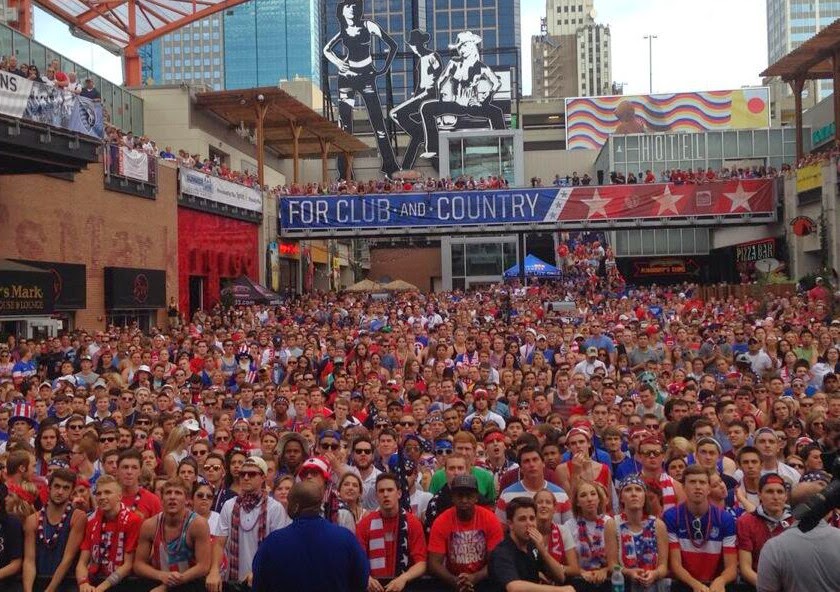
1) It was the most diverse crowd I had ever seen at a major-league level sporting event, live or televised.
This is not to say that MLB or NFL crowds are lily-white; it is to say that the Sporting crowd defied that particular duality in its diversity.  I did not see any identifiably Native American folk in the crowd, but that's about all that was missing.  Remember, we're talking about Kansas City here, smack-in-the-middle Kansas City.  Where were these crowds at Royals games or Chiefs games?  Also important here is a secondary point:
1a) This diversity of people came to the match together, or at least met at Sporting Park and hung out together at the game.  Baseball games can be diverse, but mostly on a black-white axis and in a more segregated fashion, though not always so and certainly not by compulsion.  I am not smart enough to know whether this is mostly because more of the crowd at baseball games is comprised of family units or if something else is afoot, but such division is usually pretty easy to spot at MLB games, and never more so to me than when at an Atlanta Braves game at Turner Field a couple of months ago.
Possibly a related point:
2) The Sporting Park crowd was young.  I refer to young adults, not children with their parents.  (This was a late start, so I did not expect to see the latter, frankly.)  How much 1, 1a, and 2 relate to and intersect with each other I do not know, but there's something there.
(Note: I haven't been to any MLS matches since moving here, but I have caught a few matches of the local USLPro side Richmond Kickers, and the above points seem to hold at least somewhat in this case as well, allowing for the different demographics of the two cities.)
Stepping away from that Sporting Park eye-opener to another point of a more general nature:
3) This fan base does not particularly care whether the USA has the best national team in the world.

Waiting for the US-Germany match at Power & Light District in KC

Check that: they do want to have the best team in the world, but they know it's not there yet and are hanging on anyway.
Here's where a lot of people get a bit mystified.  We are virtually the only country in the world where American football (you know, the one with the pads and CTE) is played.  Baseball might just be more popular in the Caribbean, Korea, or Japan than it is in the US by now, and it's making surprising headway in Europe, but despite somehow failing to win the World Baseball Classic so far, most would agree that the gravitational center of the sport is still here.  Basketball is about as "American" as a sport can get, in that we actually can point to a place and date and person for its invention in this country; that said, the moment US teams started getting beat at the Olympics we suddenly found it convenient to release NBA stars to play there, insuring that we won't lose another Olympics for quite a while.
We're not winning the World Cup any time soon.  Even the coach gets this.  The US team is certainly better than it's been in a long time and seems to be improving tremendously in recent years, but put us in a regular rotation with Brazil, Argentina, Germany, etc. at their best and we're going to take our beatings.  This does not bother soccer fans in the US, many of whom (traitorous pigs that they are) openly root for other countries, and others of whom get that the US has a long ways to go and are in for the long haul (I place myself here, for what it's worth).
This kind of thing infuriates some people.  They are baffled and angered when thousands of people gather in large public spaces in Chicago or Kansas City or other oh-so-American cities and live and die with each cross or header or save.  That's not American.  What's wrong with them?  
I could (and may yet) write a huge number of posts about the ethical failings of the World Cup and its overseer organization FIFA (an exercise in shooting fish in a barrel, to be sure): the feckless waste of resources on stadiums that will go unused after the Cup is gone; the deplorable state of Brazilian infrastructure ignored in the quest to put up said stadiums; the complicity of ESPN and like media in steadfastly pretending these things are not true and that many Brazilians have not protested these things, just to name a few.  Still, there is something stunning about the way that the sport and its banner event have managed to wear down American resistance and carve out a pretty substantial swath of allegiance and impact not just within my lifetime, but within my adult lifetime.  It's a different demographic, with different ideas about how the world works and a decided lack of interest in perpetuating old stereotypes and rules.
Of course this is going to tick some people off.

Tuesday, June 3, 2014

Help wanted: understanding "professional" youth baseball

The local minor-league team, the Richmond Flying Squirrels, is an affiliate of the San Francisco Giants.  A few weeks ago, the local fishwrap ran a feature on the Giants' policies concerning the protection of the young pitching arms they hope to have ready to step in if Madison Bumgarner or Matt Cain can no longer carry the load someday.
It is an interesting read from a pure baseball-geek point of view.  For example, the question of pitch counts for young arms isn't a new one.  Most organizations mandate a fairly strict monitoring of the number of pitches a young guy can throw in a game.  This was, however, the first time I'd seen a policy about the number of pitches a pitcher can throw in an inning.  It's not unfounded; there has been a decent bit of research suggesting that pitches thrown under greater stress -- in a tight situation in a game, for example -- take more out of an arm than those thrown in less stressful situations.  An inning where the pitch count has gotten as high as 30 is almost by definition going to include some high-stress pitches.  So all in all that part of the article seems pretty sound.
What got me stressing comes later in the piece.  Bert Bradley, the Giants' minor-league pitching coordinator quoted much in the article, reveals in some of his comments a bit of what's going on among some young ballplayer wannabes and presumably their parents, something that makes me break format for this blog and look not at the fan relationship to sports through faith filters, but to ask questions about those who are more directly participants in the whole enterprise.
For those not following baseball much this year, what's wrong with you?  Aside from that, one of the larger stories in the sport this year is the number of extremely good young pitchers (including the closest thing I have to a man-crush in professional sports) missing in action due to the necessity for Tommy John surgery, a procedure in which a tendon from another part of the body is moved to the arm in order to replace a torn or otherwise damaged ligament there.  It's been enough of a concern to draw a statement from the American Sports Medicine Institute offering a potentially scandalous suggestion to pitchers: don't throw so hard, at least not all the time.

*Sob* *Sniff*

Bradley, in the Richmond article, wonders about two different problems; young players throwing curveballs too young (his response to parents asking about their kids learning such a pitch at age 11 -- "not from me he won't" -- is priceless, and his his advice for a young pitcher not to throw curves until they can shave is pretty cool too) and players playing too much baseball, and specifically pitching too much baseball.
I'm not sure which angle about this phenomenon bothers me most.  Is it the determination that the only thing that matters about your 11-year-old son is that he be groomed for professional baseball?  Or is it doing so in a way that makes the kid less likely to get there?  Or is it the idea of "professionalizing" youth sports?  Having kids pitch so much as ten-, eleven-, or twelve-year-olds that their arms don't ever get to rest?  Somehow this seems to miss the points of kids playing games, you know, playing games.

How long is this arm going to last?

Here's where I have to ask help.  I'm not a parent and won't be one.  Somebody explain to me the appeal of this -- the somewhat "professionalized" baseball travel teams, playing through what used to be called an "offseason," kids throwing so much they end up needing Tommy John surgery before they get out of high school.  What's the appeal?
I was no athlete at any point of my life (everyone who has seen me try is allowed to nod knowingly at this point), but I did put out an effort.  I never much played football, but I did at least try to play basketball or softball in their appropriate seasons (soccer hadn't hit at that point, and hockey had no hold that far south), and moving from one to another was, well, part of the progress of time -- "basketball season" was followed by "baseball season" (or softball for me; I really wasn't good).
So I need the help of you parents.  What is exactly the point of such endeavors?  I'm not being facetious; I really want help understanding the motivation for the perpetual baseball thing.
Is it the kid's choice, or the parents'?
What kind of expenditure is involved, and what is the expected return?  What is the child supposed to get out of it?  What is the benefit to their development as a human being?
And why in the hell would you have your child throwing curveballs at age eleven?  That's been a no-no since I was a kid.
What is the ethic behind this?  What is the developmental thing that can only be gained this way?  What is the gain versus loss versus playing a different sport, or actually getting homework done (or, heck, I don't know, going to church on Sunday? Had to get that one in there, seminary graduate that I now am) or reading a freaking book or who knows what?
So I need comments.  What is the point of making your child's baseball something a lot more like a professional endeavor?  Or is that what it is -- is this really what the child's idea of fun looks like now?

Thursday, May 15, 2014

What games show us about ourselves

We don't have cable.  We keep a Netflix account so we can watch mostly British shows and some old Star Trek shows, and my annual anniversary gift is a subscription to mlb.tv, plus we have a whole heap of DVDs and Blu-Ray discs, so our entertainment needs are plentifully met in our house.
There are losses, though.  I don't get to see The Tonight Show With Jimmy Fallon.  I didn't expect to find that such a loss, mind you.  To me, Fallon was the guy who kept cracking up during Saturday Night Live sketches, and one of the perpetrators of one of the worst semi-baseball-ish movies of my lifetime, Fever Pitch.  (I would go so far to say that that particular movie was the one that convinced me not to be such a completist about baseball movies -- it's o.k. to miss some of them.)
Thanks to the miracle of YouTube, I'm starting to think I might be missing something.  Having Idina Menzel sing "Let It Go" accompanied by The Roots playing children's classroom instruments was inspired and will be hard to top.  Another of his stunts, though, while funny in so many ways, makes me think a bit about how we treat our sports heroes.
Robinson Cano, longtime second baseman for the New York Yankees, made his first appearance in New York recently with his new team, the Seattle Mariners.  Fallon convinced Cano, who signed a crazy megabucks contract to make the move, to go out into NYC and get booed before he even took the field.  Watch the video here.  Go on, I'll wait.
You've seen it?  No cheating, now.
Now you've seen it?  Good.
You see what happens.  Fallon's lackey persuades each jaded cynical New Yorker to boo at the big glossy photo of Cano, which some do with more vehemence than others.

Booooooooooooo!

When they turn to boo again, all of a sudden Cano's there.

Boooo -- oh, hey, Robinson Cano!

In not one case does the fan continue to boo.  Some react with a bit of shock, one with something that looked like fear -- "oh, crud, he's gonna kill me" -- and some manage to slip seamlessly from booing into glad-handing and merriment, which would seem a little psychotic to me if the whole situation weren't so lighthearted from the outset.
None of the fans really hated Robinson Cano, when facing him in the flesh, no matter how angry their sentiments might have been when Cano signed that contract.  About the meanest thing any of them managed to say to him in person was to hope he played well, but didn't win, which is about as fair a wish as can be made for a player whose team is playing against yours.
Interesting how suddenly being face-to-face with Cano made such a difference.
Of course, Fallon's little experiment isn't exactly scientific.  The passerby involved were specifically being encouraged to "boo" the Cano picture, which is not at all like being in a stadium in the heat of the moment.  Still, the difference between anonymity and presence does show up rather strikingly.
Of course, I'm not entirely sure that booing in the stadium is the best example of how anonymity liberates the lesser impulses within.  While you can still get some serious demonstrations at the ballpark or arena, it usually takes something more than leaving for a fat contract to get them to happen for more than a few at-bats.  The Internet, on the other hand...
Of course, that doesn't apply just to sports.  Perhaps it reaches its worst depths on the subjects of politics or religion.  Maybe this is a case where fan behavior at games should have been a warning to us all, rather than being the end-all of human depravity.
The fat contract itself, of course, would be a worthy topic of discussion.  But as always here, I'm a bit more fascinated with the ethical choices fans make, and what degree the Christian faith tradition (I'm certainly not qualified to speak from any other perspective) can or should inform that choice.
That said, I'm not going to be as down on one good boo as you might expect.  Note that: one good boo.  You've expressed your disappointment with, in this case, Cano's choice to leave with one good lusty boo; fine.  Now move on.  Get back to cheering for the players who are actually still on your team.
Which to me makes it interesting that none of the fans in the Fallon clip, given the opportunity to ask Cano directly why he could leave the Yankees, did so.  Most turned basically into fumbling starstruck fans when confronted with Cano's presence.  Either (1) these are raging hypocrites, or (2, the more charitable option and the one I'm taking for now) they really don't hate Cano, even for leaving their team; the boo is more of a societal expectation than a genuine measure of hurt or anger.  Then again, the in-stadium experience is likely to be rather different.
It's as if they know it's really not right or ethically justifiable to disparage a player (who is, after all, a human being) that way.  Being in a crowd in the bleachers provides a nice little mask of anonymity and distance from the offending player, so that moral twinge is harder to feel.
Still, based on totally unscientific observation (i.e. watching sports for many years), I can't help but feel that in-crowd behavior is not nearly as awful as it used to be.  (Outside the stadium, on the other hand, it can still be horrific, as Bryan Stow can tell you, or maybe his family can on his behalf.)  I suppose that may be tested this coming NFL season if Michael Sam makes the St. Louis Rams roster. I'd also notice that this characterization probably does not apply to European soccer.
Still, there's something there that should have been a warning, a source for concern rather than an occasion for jokes about Philadelphia fans booing Santa Claus.  It's not always about the game.  Sometimes it's about what the game shows us about ourselves.

Friday, May 9, 2014

No luck finding an out

So the NFL Draft is ongoing as I write.  All the big hype went to the first round last night, with unseemly levels of outrage and angst over who got drafted when or didn't get drafted until or didn't get drafted at all, having to wait for the indignity of being drafted in the second round.  Horrors.
In the meantime I must report that, alas, I found no ethical way back into football.
Yes, I actually used my final paper for my spring ethics class to find a way to follow football as a fan -- not so much for myself, but as an exercise that might be of some comfort to others.  I couldn't find it.
Some basic details:
1) Tertullian and Augustine basically mocked me for even asking the question.  While there were others of antiquity who expressed their horror/disgust/general rejection of "the games" as a general phenomenon (no, their scorn was not limited to the gladiatorial contests; pretty much any competition was repulsive to them), those two were the most extensive in their denunciation of the games and their deleterious effects -- on the competitors to be certain, but most especially on those who watched those contests.  Augustine in particular wrote of his acquaintance Alypius, who seems to have been turned into a stuporous drooling lump by the sight of the games.  Tertullian was particularly scornful of even the attempt to justify viewing the games, or for that matter the theater.  There isn't, on the other hand, much of any attempt in early Christian thought to address those games in anything like a positive way, despite the occasional encouragement towards physical wellness in the form of metaphors like Paul used from athletic endeavor.  Let's be clear that the point is not to equate football with the gladiator contests.  Even as there is a great deal of disfigurement involved in the modern game, it doesn't actually kill people -- at least, not immediately.  Long term?  Well, we've covered that ground.
2) Shockingly, I didn't find any kind of ethical comment on the First Deadly Age of Football.  That, as sports buffs recognize, relates to the earlier days of the game, when President Theodore Roosevelt stepped in to demand changes to the game in 1905 after a number of deaths due to on-field injuries.  Perhaps it was Teddy's response that short-circuited any response from the Christian ethicists of the day, but I frankly was surprised to find nothing commenting on the game and its particular destructiveness at that point.  (There were comments from earlier, in the late 1800s, but they tend to react against sports more generally -- baseball as much as football -- and for general roughness of character as much as physical harm, if not more.)  NOTE: if you know of any comment from that particular period specifically on football and hits physical harms, please let me know!
3) There has been a decent amount of comment on sports more generally as a part of society and culture, and Christian reaction to/embrace of it.  These sometimes seek to explore Christian participation in sport, while others specifically explore fanship and its relation to Christian thought and behavior.  As most of them were written before the severity of football's brain-trauma crisis became clear, most of them do not address the subject.  One exception is Shirl Hoffman's Good Game: Christianity and the Culture of Sports (Waco: Baylor U. Press, 2010), which acknowledges some of the earliest cases of CTE to gain publicity but situates CTE within a broader range of injuries related to football.  Still, though, the most prominent publication on the subject remains in the secular sphere, with the bellwether volume League of Denial as the most prominent book to address the subject.
4) Specific comment on football and CTE is only starting to leak out, in smaller but more widely accessible media such as journals and blogs.  One example of the latter can be found here, in which a Virginia pastor comes down on the side of giving up the sport.  The journal Christian Century has taken to a good bit of comment on football in its blogs and some articles, and some of those address the specifics of the CTE issue and Christian response.  Benjamin Dueholm can't abide it anymore, while Rodney Clapp still tries to find a way to enjoy the sport.  Clapp's position is rather unimpressive: because the violent aspects of the sport are not those he enjoys, he takes it as acceptable to continue to follow the sport.  Dueholm is less sanguine: he rigorously pursues a more stringenly ethical course, noting that (in a real money quote) "social ethics, especially Christian social ethics, does not wait upon the letter of the law or defer to the judgments of 22-year-old men when deciding which things should be embraced and which things shunned."
And therein is the challenge.  Even the question of looking for loopholes becomes an ethical problem.    As long as this cloud hangs over the sport -- one in which lives have already been lost, and others irreparably (so far) damaged -- any following of the sport is going to be, at best, tainted with a form of ethical guilt.  No matter how flashy the spectacle, no matter how much characters like Johnny Manziel or Richard Sherman or others are ready and willing to jump up and distract you and me from the physical destructiveness of the game, giving it our allegiance is never going to be less than problematic at best, and quite possibly (quite likely) unethical as well.
Sorry, folks.  I tried.

Wednesday, April 30, 2014

Sterling, Silver, Tarnish

Wow, so many possible subjects to blog upon.  The most obvious one, and most current, wins out though.
So the NBA has grabbed not only sports headlines, but news thunder as well.  The owner of the Los Angeles Clippers, a longtime scumbag named (or renamed) Donald Sterling, was handed a lifetime ban from the NBA along with a $2.5M fine, and NBA commissioner Adam Silver also let it be known he would seek from the rest of the NBA's owners a move to force Sterling to divest himself of the team altogether.
There has been enough comment on this to choke a herd of elephants, but I will try to add a small amount of worthwhile stuff to the fire.

Dude has another business, you know.

1) The description of Sterling above as "longtime scumbag" is not accidental.  If you've followed this story much you've learned, if you didn't already know, that Sterling has had legal issues as a landlord/slumlord, including federal suits that were either dropped or "settled," i.e. bought off, hinging on discriminatory practices by Sterling against various minority groups.
This has begged the question: why were those explicit examples of raging bigotry not important enough to provoke action from the NBA, but these most recent words set the world on fire?
This isn't a unique spot.  I can't help but recall the Chick-fil-A kerfuffle from a few years ago; Chick-fil-A had been giving plenty of money to anti-gay groups for some years before head honcho Dan Cathy made some impolitic remarks to a reporter, but large-scale outrage didn't get going until that interview got published.  It would appear that actions do not, in fact, speak louder than words.
Some caveats: a) Adam Silver is a new commissioner, so we can't necessarily assume Silver wouldn't have acted differently in the past, or that former commissioner David Stern would have acted the same way as Silver has in this situation; b) this is a different NBA than a few years ago -- whereas Michael Jordan didn't dare speak out on anything lest his advertising revenue get dinged, current players are more likely to voice opinions even in non-basketball matters, as witness the LeBron James-led Miami Heat hoodie protest in the wake of the Trayvon Martin murder.  To a great degree the NBA has far outstripped the NBA, NHL, and (as much as it pains me to say) MLB, which Jackie Robinson might not even recognize anymore.  (I would contend that MLS may well be near the NBA in terms of the overall progressiveness of its players and management, which would set it apart not only from its fellow American major leagues but especially from its European counterparts.)

2) Embarrassing ownership isn't new; ask anyone who remembers Marge Schott with the Cincinnati Reds.  That ended up being a difficult, drawn-out spectacle for MLB, but ultimately the owner, prone to say embarrassing things about her players and unpleasantly nice things about the Nazis, was eased out of the game.  The swiftness + severity of the NBA's action is the new thing here, and it is striking indeed.

3) As usual, a great deal of confusion about the First Amendment has followed in the wake of this action.  As far as I know, Sterling will continue to have the right to vote in federal, state, and local elections, and can continue to express repugnant opinions to anyone he chooses (although he might want to be more alert to the presence of recording devices).  The NBA, which like most sports leagues exists in a murky realm between business conglomerate and private club, is free (even more so than most leagues, so specific is its governing document) to take action against any owner who brings harm to the league, including removal if need be.  Considering the degree to which American courts have been ratcheting up corporate power over employees of late, saying that Sterling somehow got jobbed is a raging act of hypocrisy unless you're basically picketing the Supreme Court daily on behalf of less oppression of workers.

4) All of this happened during the NBA's playoffs, which would be an excuse for most leagues to sweep it all under the rug until after the finals (or longer if possible).  I haven't followed the NBA in years, not since Dominique Wilkins left the Atlanta Hawks (save for a short period around the Miami Heat's first (pre-LeBron) NBA championship, when I was living in West Palm Beach), and yet I found myself drawn to a Pacers-Hawks playoff game in the airport the other day, before all the Sterling mess had really hit.  That this all got settled before it had the chance to become a festering boil on the league's showcase event makes it yet again more impressive.

5) The NBA, by a large margin, includes more African-American athletes by percentage than its other major-league sports.  One suspects that another league would not have reacted so swiftly and decisively (it's impossible to conceive of the fossil known as Bud Selig doing anything decisively in MLB), again with the possible exception of MLS.  But then, we don't know that for sure.

All in all, it's a mixed bag at the moment.  While there is some satisfaction on seeing action taken, it's still hard to stomach that this particular scumbag's actions over the course of decades -- actions that directly made people's lives worse -- weren't enough to draw a peep from the NBA.  People could not get housing, or were harassed about their race or ethnic origin for decades -- not powerful people, but folks who don't have a lot of other people in their corner.  While I appreciate that Magic Johnson's feelings were probably hurt by Sterling's words, there is no way Johnson was as hurt by Sterling's words as any number of tenants in Sterling's slum dwellings.  Yet our hearts bleed for Johnson, or Chris Paul or Blake Griffin, but we pretend those black and Mexican and Korean tenants don't exist, much less that their plight is worth our concern.
The least of these, folks.  These are the ones Jesus wanted us to be concerned about and to speak for because their voices were not heard.  I'm pretty sure that Magic Johnson can take care of himself.  Chris Paul and Blake Griffin and others have a certain amount of clout themselves; even a hint of a game boycott had the potential to bring the league to its knees.  We're ready to rally against Sterling because of words, but he and his ilk can practice raging injustice with impunity, at the cost of a few million dollars at worst -- chump change to his like -- and we yawn if we react at all.
I can't help but think this incident, even it has come to a far more satisfactory ending than most thought possible, points again to one of our worst practices where sport and faith again fail to intersect, or perhaps intersect in the wrong way.  Where is our outrage, and why does it show up in places where it's not inappropriate, but perhaps not as needed, and fail to show up where it is absolutely needed and where Jesus demands that it appear?
It's hard not to conclude (in a phrase that could probably be appended to every entry on this blog) that sports matters too much.

Saturday, April 12, 2014

How long?

OK, I'm asking here.  I'm a bit lost, confused, and not a small amount angry.
How long is it going to go on?
Got to the seventh inning.  Ready to stand and stretch.  Sing "Take Me Out To the Ballgame."  No, it doesn't make real sense -- we were already at the ballgame, after all -- but it's what you do at the midpoint of the seventh inning, and it's fun, and one of those few occasions when you get to burst out in song in public and nobody says anything about it or questions your sanity.
Except, no.
First we have to sing listen to a trumpeter play "God Bless America."
Why, exactly?
Why now?
Why I don't get it:
1) We already begin each game with "The Star-Spangled Banner," which, as you may know, is our official National Anthem (and which, as you may know, turns 200 this year.  Remember Fort McHenry?  That was in 1814, gang)  As the official anthem, it is the appropriate musical venue for taking off your cap, offering salute or hand over heart as appropriate to your station in life in the direction of the nearest flag, and maintaining silence (or more ideally, singing, although most public renditions of the song do not make that possible, serving instead as American Idol auditions).  Other songs do not have that status.  Why are we dishonoring our actual anthem by according these marks of official respect to a song which has no such status?
2) It's not very universal or inclusive.  You don't believe in God? Or you have to urinate urgently? F**k you, stand still anyway or we're going to hurt you (just ask fans at Yankee Stadium).  At the very minimum, "The Star-Spangled Banner" evokes a moment in our nation's history where its very survival was far more threatened than it is now.
3) It's really, deeply awful theology.  Even after you've gone and recited a number of ways that God has clearly already blessed the particular bit of geography that ended up being "America," you still have the nerve to turn around and demand that God bless America (even though we continue to insist on desecrating all those blessings we just sang about for the sake of our mindless consumption)? Maybe act like you appreciate the blessings we've already received first before turning around and doing that.
4) (Baseball only) It busts a big hole in the fun of going to a baseball game.  Football is made for militarization and indulges it rather frequently.  Baseball is not.  Trampling over the traditional joyful silliness of that seventh-inning stretch shatters all of the pleasures that are unique to baseball.
4a) Last night's incident tried to pretend that 4) above isn't so by doing the abrupt about-face of singing "Take Me Out To the Ballgame" right after GBA.  So which one are we supposed to believe? The two do not go together, to the effect that neither one seems particularly sincere or intentional.
I'm fully aware that I'm probably alone on this.  I don't care.  It's gone on long enough, or too long.  If you are somehow of the opinion that paying respect to our nation by singing the National Anthem before the game is even allowed to start is somehow not patriotic enough for you, I fear for your soul.
You want to convince me you're a "real patriot"? How about you don't desecrate the land for the sake of your own mindless consumption?  How about let's not pretend that the blessings of being American are not reserved only for those who can afford them, or for those who belong to your political party?  How about you don't pretend it's your business to tell God who God has to bless or must not bless?
Any of these would be a far more effective and meaningful display of patriotism than a redundant interruption of a baseball game.

Sunday, March 9, 2014

Stadiums, race codes, and cold hard cash, part II: the Richmond dilemma

Back in November, I used a column to go off on the Atlanta Cobb County Braves' plans to ditch Turner Field and decamp to the suburbs as indicated in the snark above.  There were financial issues, there were race issues, there were urban/suburban issues, there were environmental issues.  Indeed that whole story was quite a feast of issues.

Atlanta is hardly the only city to face questions about stadiums and their upkeep and financing.  Perhaps the most notorious fleece job of late was down in Miami, where the Miami-Dade municipality ended up on the hook for the bulk of the cost of Marlins Park, to the point that some elected officials quickly found themselves no-longer-elected officials.  But there are other examples -- the Yankees sticking NYC with the tab for the current, bloated iteration of Yankee Stadium, and the Mets doing likewise with Citi Field or whatever it's called now; the bizarre spectacle of Los Angeles, the second largest city in the US, not having an NFL franchise despite two venerable stadiums (and former Super Bowl hosts) in the greater metro area; the heist that transformed the Seattle SuperSonics into the Oklahoma City Thunder; and so forth.

One doesn't hear about these kinds of kerfuffles when it comes to non-major-league sports, but the issues don't necessarily avoid the minor leagues.  Here in my current location, Richmond is undergoing a protracted stew over the proposed replacement of The Diamond, a 70s-vintage stadium built for the Braves' AAA franchise of the day.  The R-Braves hotfooted out of Richmond for the Atlanta suburbs some years ago, and after some wanderings in the baseball-less desert the city finally attracted a new tenant in the form of the San Francisco Giants' AA franchise, which had been somewhere in Connecticut previously.

The team, renamed the Richmond Flying Squirrels (I kid you not), has played in The Diamond since 2010, and has, to quote the Richmond Times-Dispatch, "become a regional asset that enjoys the public's affections to an extent the R-Braves did not."  The management of the franchise has worked hard to be an attractive and good neighbor in the city, offering the over-the-top in-game attractions typical of many minor-league teams, the kind that are so prolific that you (not me, specifically, but perhaps some of you) might even forget a game is going on.  They've made good connections with local businesses, sponsored activities outside baseball season to benefit the community, and generally hit all the right marketing and community-relations buttons during its tenure here.

There is one small issue, though, on which the organization has, even before relocating to Richmond, been unequivocal: The Diamond had to be replaced.

The Diamond, exterior (right field/first base side)

To put it kindly, The Diamond is an odd duck of a stadium.  From a distance it can look a bit like a UFO broke apart in midair and half of it landed here.  For a minor-league stadium it feels huge, even though it isn't necessarily all that big, I guess.  

Aerial view of the Diamond, with a team logo cut into center field.

As the above picture shows, while the stands feel a bit ginormous, the only extend a small stretch beyond first and third bases, and there is no outfield seating.  It is basically surrounded by its own parking lot, and as the picture suggests, the stadium hasn't necessarily gotten surrounded by a lot of commercial development on its street, The Boulevard (clever names seem to abound).  To be honest, that stretch of The Boulevard is a little bleak.

Hey, who turned out the lights?  This has happened more than once.

To put it a bit more bluntly, The Diamond has seen better days.  I don't know if it's an issue of upkeep, or if what worked in the 70s was a bit shortsighted, or what the issue is, but the best I can say of it as a place to watch a ball game is "it's okay."  Concourses for getting around the stadium are a bit cramped, the bathrooms need help badly, the concessions facilities struggle with large crowds, and the sight lines from the stands are fairly bad unless you're directly behind home plate.  

Apparently the parts of the stadium not populated by fans have bigger issues.  A substantial chunk of the left-field fence was taken out in a strong thunderstorm back in 2012.  The clubhouses for both home and visiting teams apparently flood easily in any kind of non-trivial rain.  And as the previous picture suggests, the power goes out a bit too easily for a large facility that tends to be highly occupied. 


Lookit the crowds! Lookit the crowds!

The Squirrels draw well.  They tend to be at or near the top of the Eastern League in attendance (admittedly, The Diamond is a bit bigger than most of the stadiums in the league, having been built for a AAA team), thanks mostly to the tireless promotional efforts of their front office.  They may in fact be undermining their efforts towards a new ballpark by being so good at their jobs.  When so many show up so readily for the big concrete thing, it's hard to persuade those so many that something better (and probably not bigger) is needed.  Perhaps inviting fans into the flooding clubhouse during the next rain delay might help.

Not everybody is so easily swayed, however.  A certain level of irritation is evidently settling in with the Flying Squirrels management (though they're far too savvy to show it in public), the parent Giants, and the Eastern League, whose president invoked the specter of a "Richmond Braves sequel" in a statement last December.  That statement, along with one from the president of Minor League Baseball (also included in that last link), seems to have prompted some movement.  The mayor of Richmond came forward with a plan for a ballpark/development plan that would move the team from that location on The Boulevard to a part of the city known as Shockoe Bottom.

One rendering of the proposed Shockoe Bottom development.

Shockoe Bottom and Shockoe Slip are two different sectors of Richmond down by the James River.  While Shockoe Slip has started to flourish as a business and nightlife location, the Bottom (cut off from the Slip by I-95) has seen spottier development.  There are some businesses and other organizations there (full disclosure: the office of the organization for which I am doing my internship this year is located in Shockoe Bottom), and it does have some of the best restaurants in Richmond, increasingly a foodie town.  It also has a lot of vacant buildings.  

It also has a microcosm of the history of slavery in the United States.  

Shockoe Bottom was the site of the second-largest antebellum slave market in the United States (after one in New Orleans).  Almost seventy slave dealers and auction houses dotted the district.  Also found in Shockoe Bottom were Lumpkin's Jail, a slave jail, and a large burial ground.  Some active excavation is still underway in the area, and exact locations of these facilities can be hard to pin down in some cases.  

Hence building much of anything in Shockoe Bottom is fraught with complications and heated passions.  There are factions who find Shockoe Bottom unendurable in its present state and badly in need of redevelopment.  There are those who are vocally insistent that any kind of redevelopment is equivalent to desecration.  And there are probably hundreds of positions in between.

The mayor's plan would include all sorts of other stuff besides the stadium in the Bottom: a grocery store and other retail locations, and of course plentiful nightlife options.  Most notable is a plan to build a long-awaited slavery memorial of some sort as part of the project.  In the meantime, The Diamond's location on The Boulevard would also be targeted for commercial development (a tacit admission that stadiums don't automatically bring a neighborhood redevelopment), probably as a sop to the building of a training-camp site for the Washington NFL franchise that first operated this past summer and an attempt to generate more commercial traffic for that site that functions for about six weeks a year.  

The mayor and council have made a few road trips in the course of developing a plan, including to Denver and Coors Field, one of the few fairly successful redevelopment plans with a stadium involved, and Durham, NC, a minor-league town that had its own struggles in replacing an aging park.  A local columnist suggests they should visit Tulsa, OK, which faced a somewhat similar situation in building a ballpark on the site of the 1921 Tulsa Race Riot.  

A series of public meetings have been held on the project, marked mostly by heated accusations and recriminations and a general lack of listening.  (At this point it's probably best to refer you to the Times-Dispatch's coverage of the ballpark issue.  The T-D is far from my favorite paper, but it has generally been decent at covering this story.)  The mayor, once roused to action by the aforementioned grumblings from the Eastern League and Minor League Baseball, has been relatively resolute in pushing the new plan, and a fairly aggressive public-relations campaign has simultaneously been pushing the concept.  (That sprang up in Shockoe Bottom pretty quickly; I showed up for work one day and there were signs all over the Bottom.)  

And there the situation sits.  

If you're expecting a fully formed answer out of me on this one, you're going to be disappointed.  I'm torn, and in many ways not totally invested as I hope to be moving away from Richmond some time in the reasonably near future.  But it is a disturbing situation that touches on many things I care about, and I can't totally ignore it.

So, a few thoughts:

1. That there has not yet been any kind of slavery memorial or museum or anything done in Richmond (capital of the Confederacy, remember) is bizarre and repulsive.  You can find about sixty million Civil War museums or memorials around here, including the infamous Monument Avenue statues of Robert E. Lee, Jeb Stuart, "Stonewall" Jackson and other Civil War figures (along with tennis star Arthur Ashe, incongruously).  There's a Holocaust museum.  There are sites related to the Revolutionary War era, and some dating back to the 1600s.  Aside from the Lumpkin's Jail site and one statue marking Richmond as a corner of the "slave triangle" slavery in Richmond is kept largely hush-hush.  That's nuts, and wrong.  If this redevelopment finally pushes along the establishment of some kind of memorial, it deserves not to be dismissed out of hand.

2. There is a lot of unknown, as indicated before, about where exactly everything was in Shockoe Bottom.  It's probably not a great idea that home plate or the pitcher's mound end up smack on top of a major slave cemetery.  Is there not a way to get some greater clarity about the Bottom before rushing into the project?

3. Shockoe Bottom is near the James River and I-95.  What about traffic off that interstate (already rather snarled on frequent occasions) or flooding?  I'm sure these have to be addressed in any such plan.  As I railed about the environmental horror of the Braves' plans in Cobb County, so I'll want to see that this isn't going to create a similar emissions nightmare for Richmond (obviously, the number of cars is going to be a bit smaller).  

4. In the mayor's and council's travels, I wish they had bothered to visit the Negro Leagues Baseball Museum in Kansas City.  It is the cite without peer for getting an understanding of baseball and race in America.  Far from being confined to the famous Negro Leagues of the 30s and 40s, the museum tracks a long history of baseball and the African-American experience and their frequent intertwining. The Richmond folk should visit for two reasons.  One, this is the place to learn how to make baseball and history work together.  Baseball is about the only sport that could possibly be moved into Shockoe Bottom and work in harmony with the history/memorial project that has to happen there.  Baseball's history is long, and may well have intersected with the lives of slaves -- it certainly was played among free blacks in various locations, and games similar to baseball are recounted in stories of slave life.  Its intersection with African-American life after slavery is much easier to trace.  (Side note: your homework assignment is to go to the Negro Leagues Baseball Museum if you're ever in Kansas City, along with the National World War I Museum at Liberty Memorial.)  

In short, baseball is uniquely suitable to be the sport in this situation.  (If basketball's history went any further back than 1904, it might have worked.)  If a stadium is going to be built in Shockoe Bottom, it better be a ballpark.  (And it better be named for Ray Dandridge.)  

5. A stadium does not have to be built in Shockoe Bottom.  They aren't magic bullets for development.  The pairing of sports facilities and memorial/museum sites is actually not without precedent; in Cincinnati, the National Underground Railroad Freedom Center, with its related story, sits nestled in between Paul Brown Stadium (Bengals) and the Great American Ballpark (Reds).  But you have to explain why it works, and how the ballpark will honor and serve the memorial/museum and the story that must be told (and avoid dishonoring site and story).  But being able to do that takes time and research and commitment.  And I don't know if anybody in the city or with the Squirrels is able or willing to do that.  

The Great American Ballpark, as seen from the National Underground Railroad Freedom Center

Some people will recoil at the thought of building so frivolous as a ballpark on what they view (and think everybody should view) as sacred or sacralized ground.  If you want to go forward, you have to take those claims seriously and make the case that it is not frivolous.  Baseball does offer a unique opportunity to do that, but it takes work.

6. On the money issue: I cannot make the case that municipalities should never spend money on sports facilities.  I kinda wish I could, but I have this problem: I like symphony orchestras.  I like history.  I like art.  And the facilities that house such things -- concert halls, museums, galleries and such -- tend not to happen without some sort of public participation.  And if I like my concert halls and museums, I'm not in the position to deny a ballpark to those who like having that available (admittedly, that number does include me too).  (And yes, there are plenty of folk who would call concert halls and such frivolous, on the brilliant reasoning that "if I don't like it, it's frivolous" -- don't be that person, folks, about either one.)

I can, however, say that no municipality should ever foot the total bill for said sports facility.  The Squirrels have indicated they will pay part of the cost in this case, though the exact proportions are not clear.  And I can say that a municipality with a 35% poverty rate should not be throwing wads of money around for a stadium without first addressing that poverty rate (looking at you, Richmond).  And please don't try to convince me that the whole redevelopment plan is going to fix that.  Developers are not particularly charitable.  

In short (too late!), I think a Shockoe Bottom stadium can make sense, and even be useful in doing a profoundly good thing and righting an injustice (something always theologically in favor).  But it takes time and careful thought and foresight, whereas in Richmond neither seems to be readily available.  This kind of process should probably have started the first time Shockoe Bottom was proposed as a ballpark site, several years ago; I see no evidence that it was.  

Of course there is time pressure; the Squirrels (along with the Giants, Eastern League, and MiLB) are getting restless, and too much more delay might provoke Nutzy the Flying Squirrel mascot to throw up his hands and stick out his thumb on I-95 or I-64 and hitch a ride to a municipality with its act together (or a bigger sucker, whichever you prefer).  But doing it right, in a way that hears all voices and respects and honors the horror and tragedy in Shockoe Bottom's history, can't be achieved by shortcut.  In a way maybe it's fitting that sports entertainment should "earn its keep" by putting itself at the service of something larger than one team, by being a servant to history and the public good.  I just wonder if anybody in Richmond has that kind of vision.

Note: the image used as the background for this blog is from one of my frequent trips to The Diamond for a Flying Squirrels game, from my usual general admission seating choice behind home plate.